Belgium: Flanders Counts Nearly 200,000 Home Batteries and Almost 2 Gigawatt-Hours of Storage Capacity

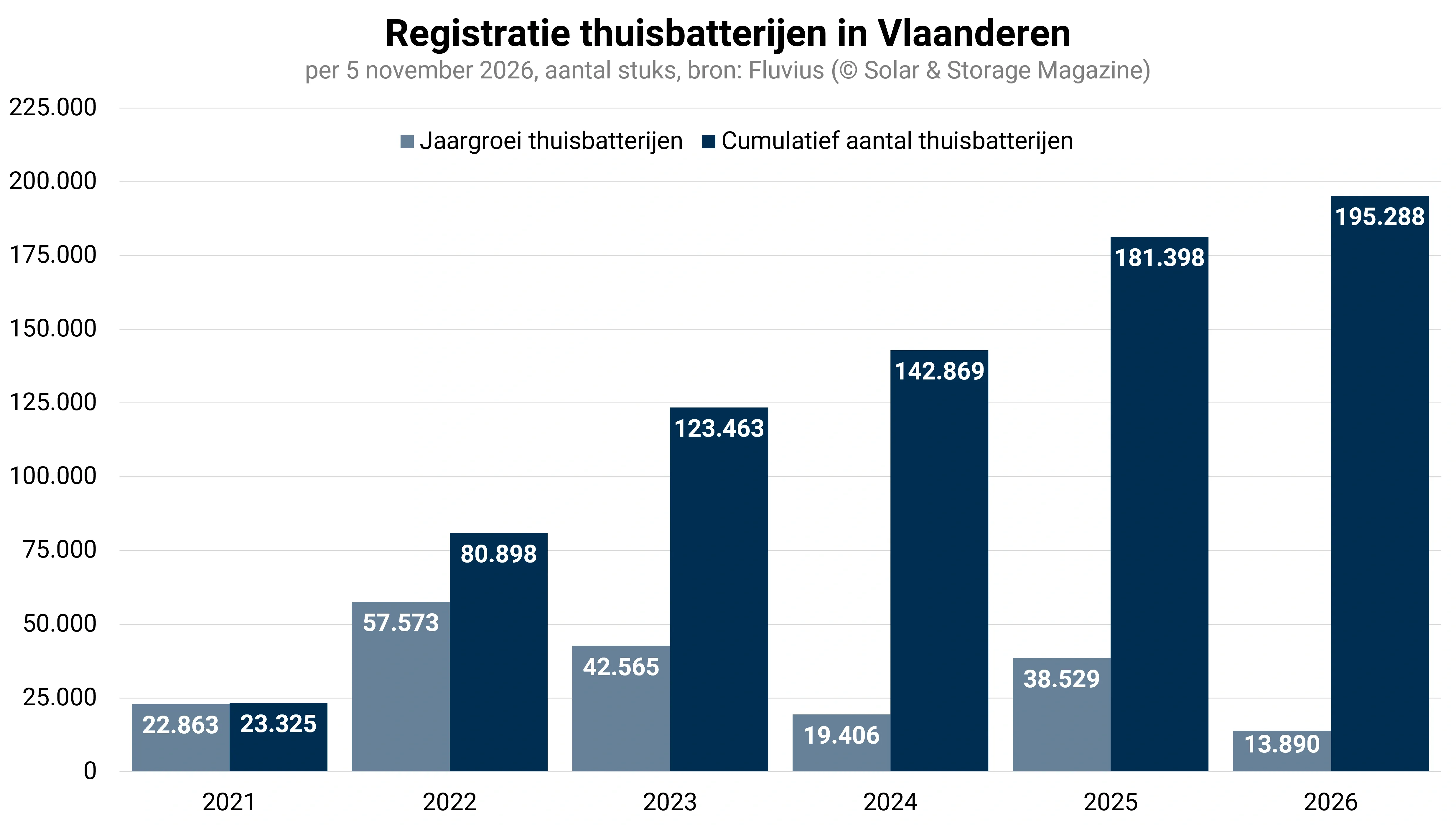
The latest Fluvius update shows that the growth figure for 2025 has been revised upward again: from 36,152 home batteries in the previous update to 38,529 units, an upward correction of nearly 7 percent. Storage capacity for 2025 was also revised upward, from 420.0 megawatt-hours to 451.8 megawatt-hours.
Adjusted by over 34 percent
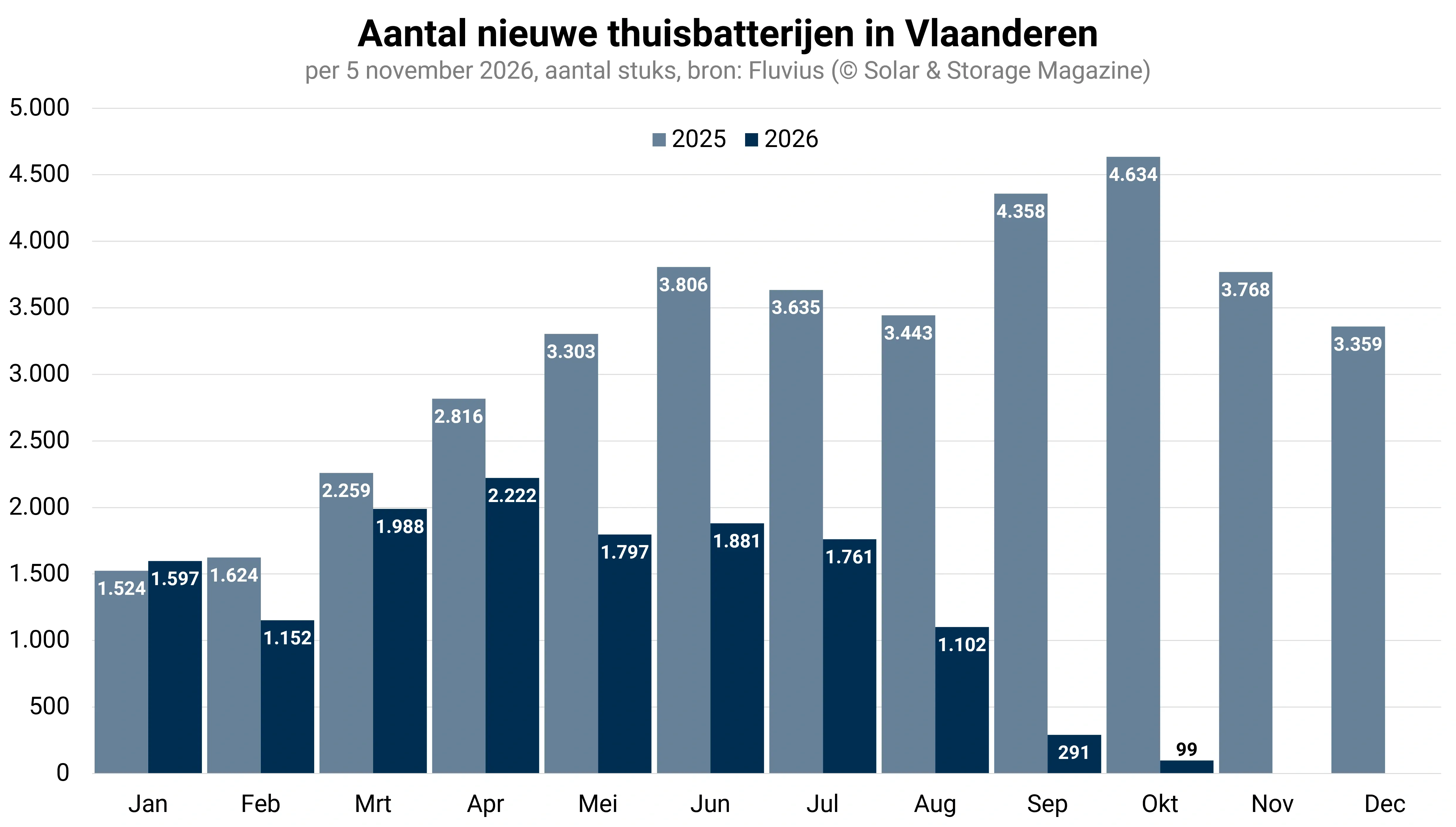
In the previous update, based on data from early September, the number of new home batteries for the first eight months of 2026 stood at 10,079. In the latest update, that figure has risen to 13,500 units – an upward revision of over 34 percent in just two months.
It has long been known that Fluvius registrations only provide a complete picture months after the fact. Earlier data showed that it can take up to six months before the figures reflect a realistic picture of the actual installation level.
Nearly 200,000 home batteries
The chart above shows how strongly the cumulative number of home batteries in Flanders has grown, from 23,325 units at the end of 2021 to 195,288 as of November 5, 2026. The threshold of 200,000 registrations is now just 4,712 units away. The annual growth in 2025 stands at 38,529 units in the most recent update – again an upward revision compared to earlier updates. With 57,573 new home batteries in 2022 – partly enabled by the subsidy at the time – that year remains the absolute peak in absolute numbers. The growth for 2026 currently stands at 13,890 home batteries, but significant upward revisions are also expected here as the registrations become more complete.
The monthly figures for 2026 show that an average of between 1,700 and 1,800 home batteries are installed per month this year. From May onwards, the numbers drop sharply compared to 2025, but that comparison only becomes meaningful once the 2026 registrations have taken on a more definitive character.
Recent months have been marked by uncertainty
The figures for September 2026 currently stand at 291 units, and for October at 99 units. Both figures are highly provisional and do not provide a realistic picture of the actual installation level.
Experience with previous Fluvius updates shows that late-year registrations can still be revised upward by hundreds of percent. It will only become clear over several months how strong the demand actually was in the autumn of 2026.
Larger batteries per installation
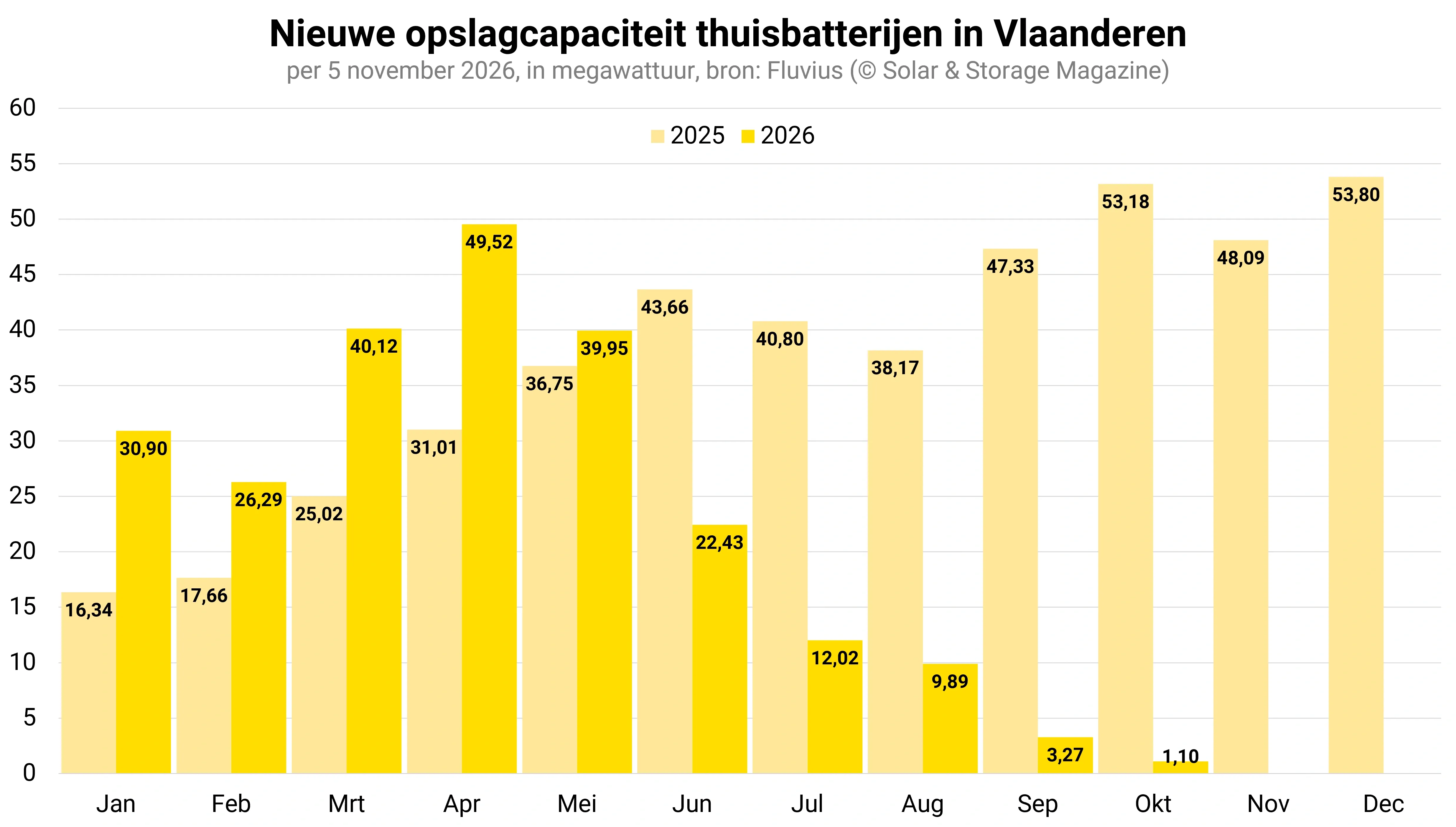
The monthly figures for storage capacity confirm a trend that was already visible in the previous update: in the months where the data is more reliable, 2026 shows a notably higher level than 2025. This indicates larger average battery sizes per installation. The capacity figures for the summer months and autumn of 2026 are currently too preliminary to draw conclusions from.
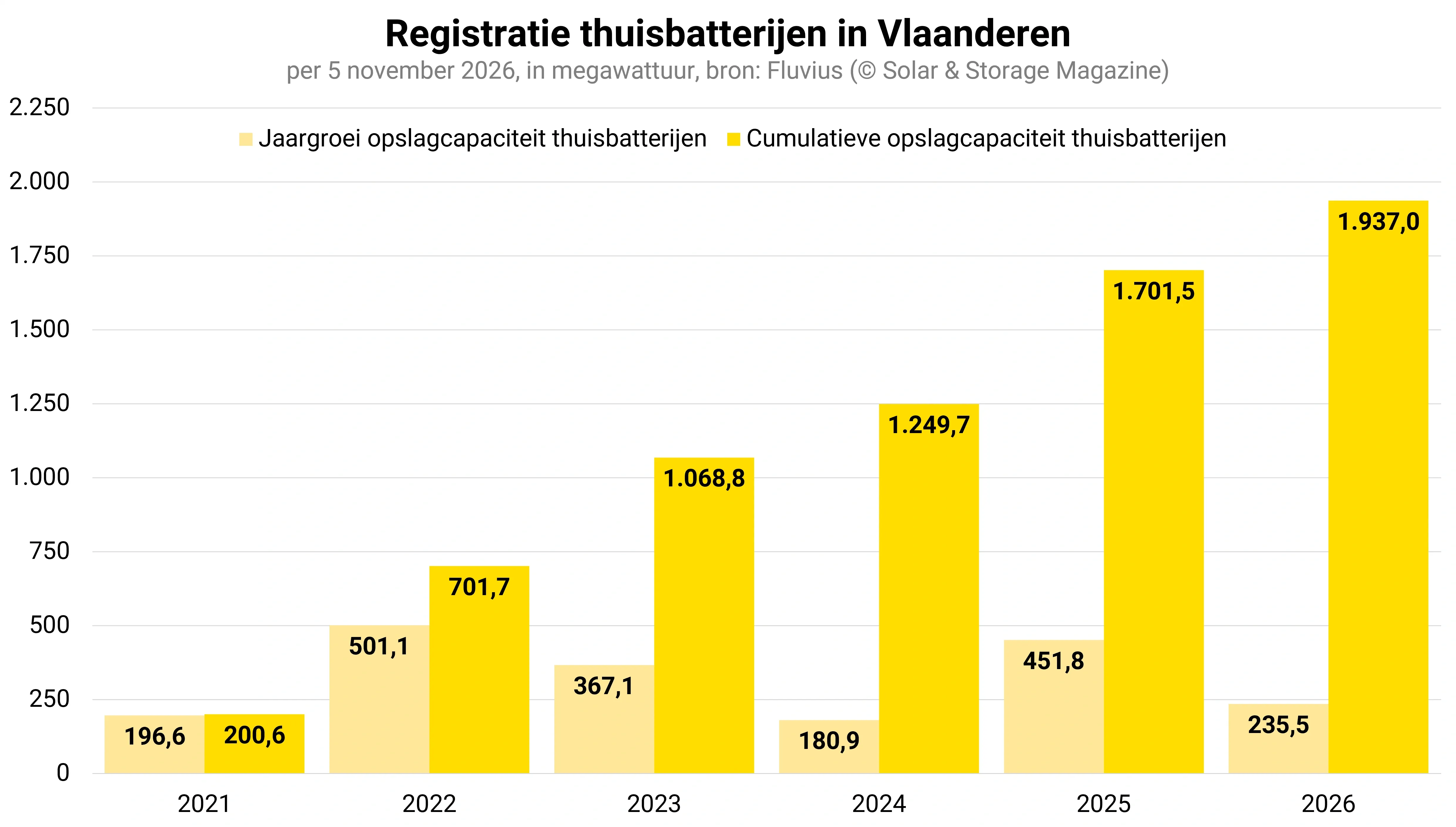
The cumulative storage capacity of home batteries is now rapidly approaching the 2,000 megawatt-hour threshold. The annual growth in 2022 (501.1 megawatt-hours) remains an all-time record, while the revised growth for 2025 (451.8 megawatt-hours) currently ranks second. The provisional growth for 2026 stands at 235.5 megawatt-hours—already exceeding the full annual growth of 2024 (180.9 megawatt-hours)—though further revisions are expected to follow.
2 gigawatt-hours reached
The total registered storage capacity of all home batteries in Flanders reached the threshold of 1,937.0 megawatt-hours as of November 5, 2026. The 2 gigawatt-hour mark has likely already been surpassed, as in practice more batteries have been installed than registered.
What is already notable in the more reliable early months of 2026: over the first five months, a total of 186.8 megawatt-hours of new storage capacity was registered, compared to 126.8 megawatt-hours in the same period of 2025. This occurred while 24 percent fewer home batteries were installed in terms of numbers. The average capacity of a newly installed home battery increased from just under 11 kilowatt-hours in the first five months of 2025 to over 21 kilowatt-hours in the same period of 2026. The average Flanders home battery has thus roughly doubled in size.
Record year for large-scale batteries
Grid operator Fluvius distinguishes in its energy storage system statistics between batteries with a maximum capacity of 25 kilovolt-amperes and batteries with higher capacities. The latter group is referred to as “ZHV” batteries in the Fluvius database.
In 2025, a total of 653 ZHV batteries were commissioned, with a combined capacity of 195 megawatts and a storage capacity of 242.5 megawatt-hours. This represents a further adjustment compared to the previous update, which reported 647 batteries with 193.6 megawatts and 241.9 megawatt-hours. In the first 10 months of 2026, 373 ZHV batteries have been provisionally commissioned, with a capacity of 177.6 megawatts and a storage capacity of 250.8 megawatt-hours. In terms of storage capacity, 2026 is already a record year. In total, Flanders now has 1,203 ZHV batteries, accounting for over 442 megawatts of capacity and 565 megawatt-hours of storage capacity.
Note: The Fluvius database includes only batteries connected to the low- and medium-voltage grid, and therefore not to Elia’s high-voltage grid.
Frequently asked questions
How many home batteries are currently registered in Flanders according to the latest Fluvius update?
Flanders has 195,288 registered home batteries as of November 5, 2026. This figure is just 4,712 units away from reaching the 200,000 registration threshold.
What is the revised annual growth in home battery storage capacity for 2025 in Flanders?
The revised annual growth for 2025 is 451.8 megawatt-hours. This figure ranks second only to the 2022 record of 501.1 megawatt-hours.
How has the preliminary data for new home battery installations in 2026 changed in the latest update?
The figure for new installations in the first eight months of 2026 rose to 13,500 units. This represents an upward revision of over 34 percent compared to previous data.