Unblocking the Rooftop Solar Power Mechanism

Once spending 4 to 5 million VND on electricity bills each month, the family of Tran Thu Thuy, residing in Ha Vi 2 residential group, Bac Giang ward, Bac Ninh province, has significantly reduced this expense after investing in a rooftop solar power system integrated with battery energy storage systems (BESS).
Ms. Thuy’s household uses a variety of electrical appliances, ranging from elevators, washing machines, and dryers to four bidirectional air conditioners. However, since the system was installed in June 2025, the family’s monthly electricity bill has dropped to approximately 300,000 dong in some months.
This reduction is achieved by leveraging on-site solar power, combined with a storage system to utilize energy during periods without sunlight.
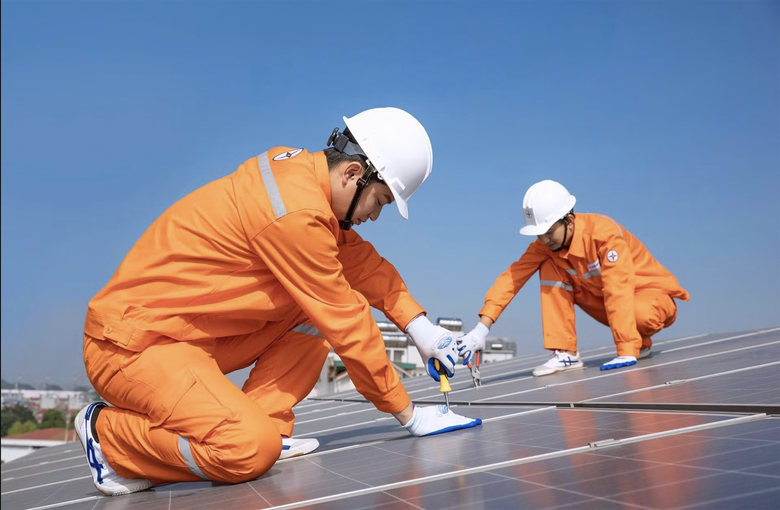
The adoption of rooftop solar is not limited to households; it is also being actively promoted at production and business facilities, which have high electricity consumption during the day. Utilizing the roof space of factories and warehouses for power generation helps businesses reduce the amount of electricity purchased from the grid, thereby cutting operational costs.
According to the Northern Electricity Company of Vietnam (EVNNPC), self-generated, self-consumed rooftop solar is growing rapidly in the northern provinces. From 10,099 customers with a total capacity of 718.3 MW at the end of June 2026, the number increased to 15,643 customers, corresponding to 929.3 MW, by the end of August.
The upward trend continued in September, bringing the total to 17,750 customers, with a capacity of 1,032.7 MW. For the first nine months of the year, EVNNPC added 16,151 new customers, corresponding to 709.04 MW.
Nationally, according to Vietnam Electricity (EVN), as of the end of August 2026, there were 134,410 rooftop solar power systems with a total installed capacity exceeding 11,450 MWp. Of these, 31,957 systems with a capacity of 1,947 MWp were developed under Decree 58/2025 and Decree 243/2026.
Promoting investment in energy storage systems
According to Nguyen Huy Hoai, a specialist from the Vietnam Energy Association, developing self-consumption rooftop solar power helps supplement local electricity supply and reduce dependence on centralized power plants. Consequently, government agencies, offices, businesses, and households can proactively meet part of their electricity demand.
However, in the context of many large-scale power projects facing delays, promoting rooftop solar power requires a comprehensive mechanism capable of sufficiently encouraging investment.
From an operational perspective, energy expert Ha Dang Son notes that if developed on a large scale without appropriate regulatory solutions, this power source could affect the stability of the distribution grid. This is also why the combination of rooftop solar power with BESS is identified as one of the solutions to reduce peak-hour load and enhance local energy self-sufficiency.
BESS allows for the storage of a portion of solar power generated during the day for use when demand peaks or when solar generation is no longer available. However, the simultaneous investment in both systems poses an initial cost challenge for users.
In response to the requirement to ensure power supply in 2027, the Prime Minister recently directed localities to urgently issue policies supporting households in installing rooftop solar power systems for self-production and self-consumption, to be completed by December.
The Ministry of Industry and Trade was tasked with proposing specific BESS development targets for each locality, particularly in northern provinces, clearly defining the quantity and the timing for putting the systems into operation.
However, according to Mr. Hoach, both the local budget support policies and the surplus electricity sales mechanism only partially address the investment challenge. Because installing rooftop solar power systems combined with BESS can cost a household hundreds of millions of dong, it is not possible to rely solely on support funds.
Research to help residents access additional funding
Therefore, in addition to direct support, it is necessary to study solutions that help residents and businesses access capital and green credit, while simultaneously strengthening technical guidance and simplifying procedures within the scope permitted by law.
On the part of the power industry, the public disclosure of processes, grid connection guidelines, and coordination with local regulatory authorities play a crucial role. This approach not only facilitates matters for residents and businesses but also ensures the safe operation of the system.
In practice, EVNNPC has proposed strengthening connectivity and the transfer of information from the public service portal to the power units that directly interact with customers. This measure aims to shorten coordination time and allow for the timely assessment of technical conditions at the installation sites.
Four localities have issued supportive policies
To promote self-consumption of rooftop solar power, several localities have specified support policies funded by their budgets.
In Bac Ninh, households installing rooftop solar systems receive support of up to 3 million VND. If they invest in an integrated energy storage system, the support increases to a maximum of 6 million VND. Hanoi has also recently approved a policy with similar support levels, planning to allocate approximately 158.76 billion VND for implementation during the 2026–2030 period.
Meanwhile, Quang Tri offers support of up to 4 million VND per household for the integrated installation of rooftop solar and energy storage systems, with a total implementation budget of 24 billion VND. In contrast, Lai Chau applies a support policy of up to 50 million VND per household for the installation of solar power systems with storage for eligible subjects who have not yet been connected to the national power grid.
Frequently asked questions
How much did Tran Thu Thuy's monthly electricity bill decrease after installing the rooftop solar and BESS system in Bac Ninh?
The family's monthly electricity bill dropped from 4 to 5 million VND to approximately 300,000 dong in some months. This reduction was achieved by leveraging on-site solar power and a storage system to utilize energy during periods without sunlight.
What is the maximum financial support per household for integrated rooftop solar and BESS installation in the specified region?
The support is up to 4 million VND per household for the integrated installation of rooftop solar and energy storage systems. The total implementation budget for this specific support program is 24 billion VND.
How does the rooftop solar and BESS combination help businesses reduce operational costs and manage peak-hour loads?
Utilizing roof space for power generation helps businesses reduce the amount of electricity purchased from the grid, thereby cutting operational costs. BESS allows for the storage of solar power generated during the day for use when demand peaks or solar generation is unavailable.