Two More Companies Announce Price Hikes of Up to 15%; Multiple Solar-Related Stocks Hit Limit-Down

On October 29, Huawei Digital Power and Kehua Data’s subsidiary, Kehua Digital Energy, simultaneously announced adjustments to the prices of their respective products, drawing renewed attention to the cost pressures faced by inverter and energy storage equipment manufacturers.
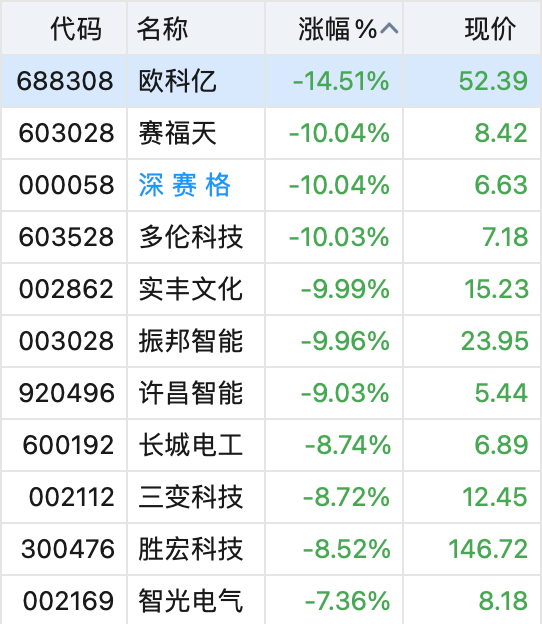
On October 30, the photovoltaic sector opened lower and traded weakly amid volatility. As of 10:23, Saifutian, Shenzhen Saige, Duolun Technology, Zhenbang Intelligent, and Shifeng Culture hit the daily limit down. Ouke Yi fell more than 14%, while Shenghong Technology, Xuchang Intelligent, Yangguang Energy, LONGi Green Energy, and GCL System Integration followed suit with declines. Tianyang New Material bucked the trend, hitting the daily limit up with a maximum order volume exceeding 240,000 lots. Estun and Sunrise Oriental rose more than 5%.
Huawei Digital Power explained in its announcement that the reason for the price adjustment is that, since 2025, global prices for bulk raw materials, PCBs, and storage media have risen significantly in multiple rounds, leading to a notable increase in the manufacturing costs of intelligent photovoltaic products. The company has actively taken measures to absorb costs and reduce the impact on product prices. To continue providing high-quality products and services, ensure stable supply, and maintain a healthy and sustainable partnership, it plans to adjust prices in the near future.
Specifically, the price adjustment range for its residential photovoltaic and energy storage products and solutions, commercial and industrial photovoltaic and energy storage products and solutions, and power plant inverter products and solutions is +5% to +15%. The adjustment range for grid-forming energy storage solutions for power plants (including PCS solutions) is +5% to +10%.
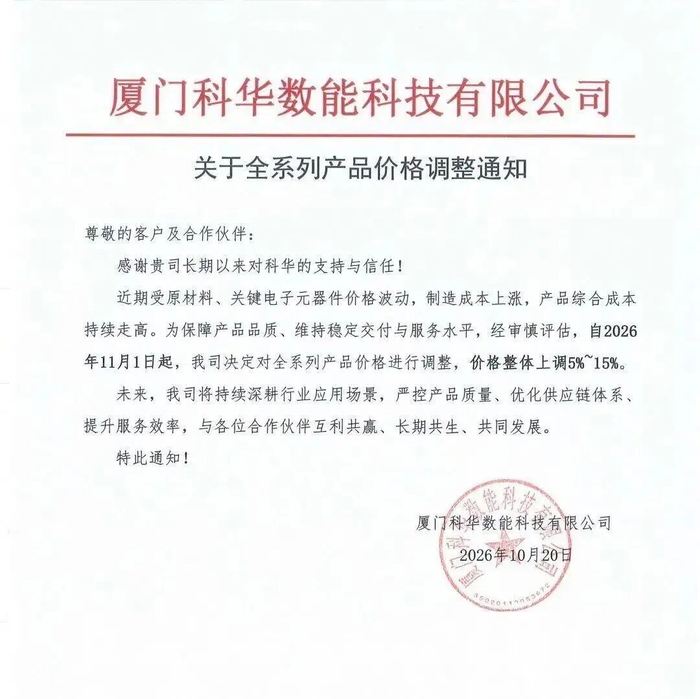
Kehua Data announced that, starting November 1, 2026, the prices of its entire product series will be raised by 5% to 15%. In its price adjustment statement, the company also noted that recent fluctuations in the prices of raw materials and key electronic components have led to increased manufacturing costs and a continuous rise in overall product costs. To ensure product quality and maintain stable delivery and service levels, the company has decided to adjust the prices of its entire product series.
This marks another round of coordinated price adjustments in the solar and energy storage equipment supply chain in the second half of this year. Previously, companies such as Sungrow, Kstar, and GoodWe had already issued price adjustment notices covering products including solar inverters, energy storage converters, and energy storage systems, with some products seeing double-digit price increases.
For the inverter industry, the successive price adjustment notices indicate that the price transmission mechanism within the supply chain is undergoing changes. However, against the backdrop of slowing growth in new solar installations and a contraction in the scale of some inverter tenders, it remains to be seen whether companies can effectively pass cost pressures downstream.
Looking back at the previous round of price hikes, Sungrow sent a product price adjustment notice to customers on September 11, announcing that starting from September 20, it would raise prices for its solar inverters, energy storage converters, and related energy storage system products, with an overall increase of 5% to 15%. Specifically, string, modular, and matrix inverters would see price increases of 5% to 10%, while medium-voltage grid-connected solar inverters would see increases of 10% to 15%.
In its price adjustment explanation, Sungrow noted that the prices of non-ferrous metals such as copper, aluminum, and tin, as well as precious metals like silver and gold, have continued to rise. Additionally, the supply of core components has become tighter, leading to a steady increase in overall material procurement costs. Previously, the company had absorbed cost increments by locking in long-term supply resources and optimizing its supply chain procurement strategies. However, the recent cost increases have exceeded the tolerance range of its existing pricing structure.
Subsequently, GoodWe also announced that starting from October 8, it would raise the prices of its string inverters and energy storage system products by 5% to 10%. The company similarly attributed the adjustments to rising upstream raw material costs, tight supply of core components, and increased production costs.
Data from Shanghai Metals Market (SMM) shows that in the first half of 2026, the average spot price of No. 1 electrolytic copper in China was 101,800 yuan per ton, a 31.07% year-on-year increase compared to the same period in 2025. The average spot price of aluminum was approximately 24,100 yuan per ton, up 18.81% year-on-year. Entering October, the price of the main Shanghai copper futures contract continued to climb. The rising prices of metals such as copper and aluminum are increasing the material costs for electrical equipment.
For inverters, copper is used not only in structural components such as cables and busbars but also extensively in electrical components like inductors. Precious metals such as silver and gold are involved in the manufacturing processes of certain electronic components and power modules. As the prices of these materials rise, the procurement cost pressure faced by equipment manufacturers increases accordingly.
Meanwhile, the price increases in electronic components also warrant attention. In July this year, media reports indicated that, driven by the explosive demand for AI computing power, high-end printed circuit boards (PCBs) have been in short supply since the beginning of the year, with prices rising sharply. The price increase for some PCBs has already exceeded three to four times.
From the demand side, the downstream market for inverters is primarily the solar and energy storage sectors. Although these two renewable energy markets are still expanding, the market conditions in different sub-segments are not entirely uniform.
Data from the National Energy Administration shows that as of the end of September 2026, the cumulative installed capacity of wind and solar power generation nationwide reached 2.01 billion kilowatts. Among this, the installed capacity of solar power generation was 1.31 billion kilowatts, a year-on-year increase of 16.5%. The continuous growth in renewable energy installed capacity provides a long-term market space for power electronic equipment such as inverters.
The energy storage market is also a key area of growth that companies are focusing on. As the scale of renewable energy grid connection expands, the power system’s demand for peak shaving, frequency regulation, and flexible adjustment capabilities is increasing. Projects such as independent energy storage and integrated solar-storage systems are being steadily advanced. Inverter companies are also extending their product lines to energy storage converters and integrated solar-storage systems, seeking new business growth points.
However, growth in installed capacity does not mean that all equipment manufacturers will benefit equally from the demand surge.
The pace of photovoltaic project development, the scale of tenders, and equipment procurement prices will continue to influence corporate orders and pricing. Taking the inverter tender market of central and state-owned enterprises as an example, public industry statistics show that the awarded capacity for relevant projects from January to September 2026 was approximately 112.94 GW, a 47.40% decrease from 214.72 GW in the same period of the previous year.
Therefore, the key to this round of price increases lies not only in whether companies issue price adjustment notices, but also in whether new costs can be effectively passed on to customers. For existing contracts, companies typically maintain the original contract prices in accordance with the execution rules specified in the adjustment notices. New contracts, however, may be subject to the revised pricing structure.
This implies that cost increases and product price hikes need to be assessed over a longer operational cycle. A company’s ability to maintain profitability depends not only on the prices of raw materials and core components, but also on product mix, supply chain management, capacity utilization, and order fulfillment.
Two More Companies Announce Price Hikes, Up to 15%; Multiple Solar PV Concept Stocks Hit Limit Down
Image News
Frequently asked questions
Why did Huawei Digital Power and Kehua Digital Energy announce price hikes of up to 15% for their solar products?
The companies cited significant increases in global prices for bulk raw materials, PCBs, and storage media since 2025. These cost surcharges exceeded the tolerance range of their existing pricing structures, forcing the adjustments.
What specific percentage increase did GoodWe announce for its string inverters and energy storage systems starting October 8?
GoodWe announced a price increase of 5% to 10% for its string inverters and energy storage system products. The company attributed this move to rising upstream raw material costs and tight supply of core components.
How did the announcement of price hikes by Huawei and Kehua affect the trading of solar-related stocks on October 30?
The photovoltaic sector opened lower and traded weakly, with several stocks hitting the daily limit down. Companies like Saifutian and Shenzhen Saige fell sharply, while Ouke Yi dropped more than 14% amid the volatility.