Germany builds world's largest retractable solar roof over wastewater treatment plant: 2,745 MW and 2.2 GWh annually

The canopy spans 17,493 square meters of aeration basins and will power the compressors used in the biological treatment process. Grid connection is scheduled for this winter, with full operational commissioning expected in 2027.
Stadtwerke Stuttgart is constructing Germany’s largest retractable solar roof over a wastewater treatment plant: a 2.745 MW system comprising 5,280 modules that will generate more than 2.2 GWh annually, representing 9% of the facility’s electricity consumption.
From aeration basins to the roof: 17,493 square meters of modules
The facility is being erected over the aeration basins of the main wastewater treatment plant in Stuttgart-Mühlhausen, in southwestern Germany. The 5,280 photovoltaic modules will cover 17,493 square meters and generate 2.745 MW upon completion of the works in the second quarter of 2027. With these figures, the municipal utility Stadtwerke Stuttgart claims the title of the country’s largest retractable solar roof.
The detail that measures the difficulty is not the power output, but the integration. The support structure and framework must be fitted into an infrastructure that continues to operate at full capacity, five meters above the wastewater. Preparatory works began in 2025 with modifications to the basins themselves; the assembly of the steel and the mobile panels started in mid-2026 and requires nearly 250 tons of steel.
Grid connection is scheduled for this winter. The technology is also not of local origin: Swiss firm dhp Technology is deploying its Helioflex system, a retractable roof that the company has already installed at other industrial sites. Stadtwerke Stuttgart acts as the developer and owner of a facility whose sole purpose is self-consumption.
How the retractable solar roof works: 120 sections, 120 motors, and zero ground space occupied
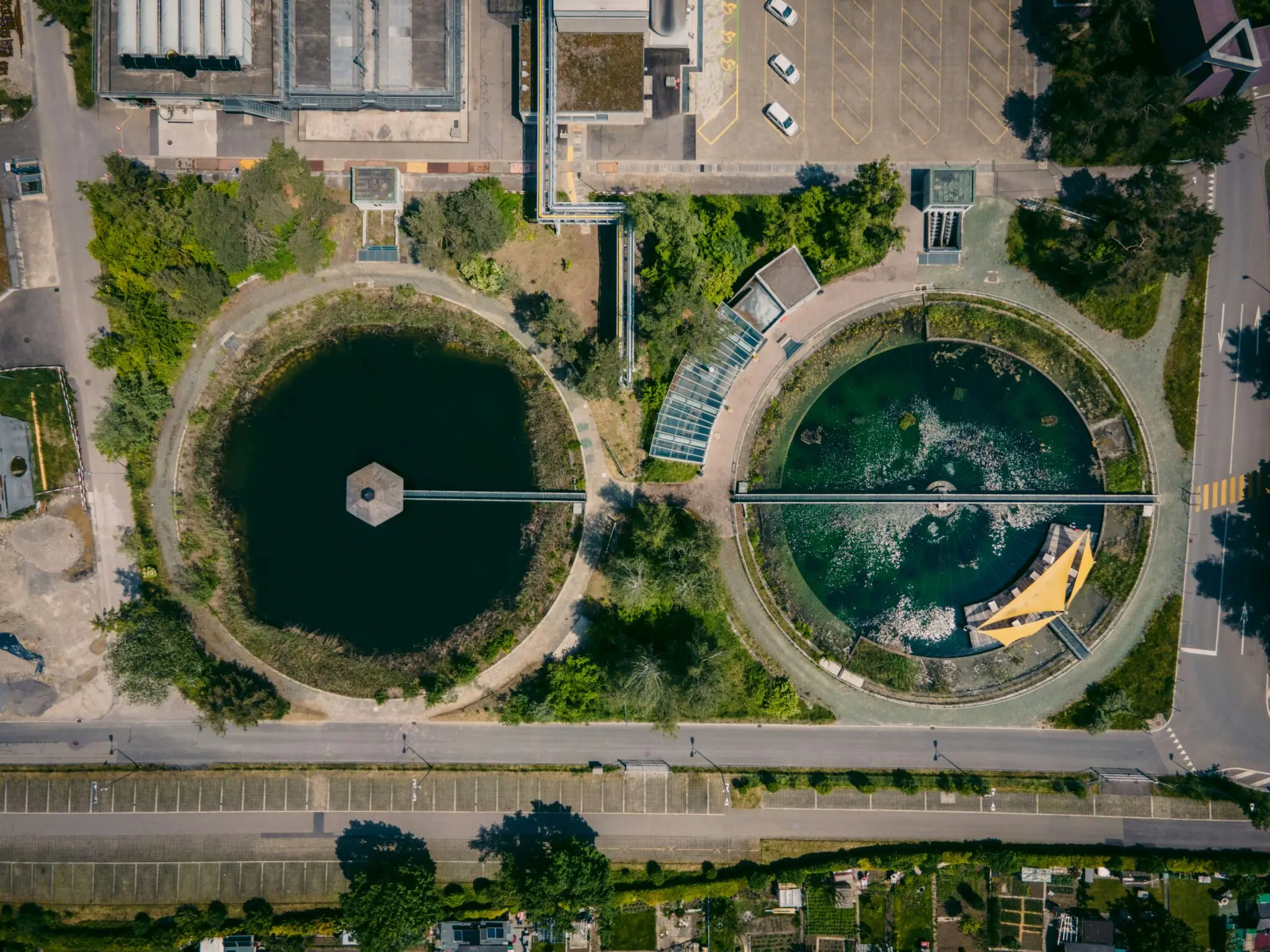
The design is organized into 120 sections of retractable roof suspended from steel cables. Each section houses 44 modules of approximately 520 W and is equipped with its own motor to extend or retract the section as needed.
The key is not only how much energy the roof generates, but that it does so without converting a single square meter of land to another use.
This mechanism addresses the classic challenge of photovoltaic systems: weather conditions. The modules retract during snowfall, strong winds, or hail, and also at night when there is no generation but a structural risk exists. The same movement allows the panels to be moved aside during crane operations and maintenance tasks, ensuring the wastewater treatment plant retains access to its equipment. In summer, the cover also provides shade for personnel working near the basins.
A facility that moves out of the way when it gets in the way is the most cost-effective way for an industrial operator to accept an energy roof.
📊 Ecological impact in figures
Dual land use: the lever for industrial photovoltaic self-consumption
The 2.2 GWh of annual generation is not fed into the grid; it is consumed within the plant itself. The Mühlhausen wastewater treatment facility is an intensive and continuous electricity consumer, with the compressors used in biological treatment being the primary load. Covering 9% of this demand with on-site generation does not make the plant self-sufficient, but it provides something more useful than a percentage: cost stability in the face of wholesale market volatility.
The underlying argument is dual land use. A ground-mounted photovoltaic plant requires hectares and competes with agriculture; this canopy utilizes an air volume that was already occupied by infrastructure and could not be repurposed for any other use. This is the replicable detail: any wastewater treatment plant, pumping station, or industrial lagoon with exposed tanks is a potential candidate, requiring no new land permits or territorial conflicts.
For the institutional investor, the appeal lies in the label. This type of project fits within the criteria of the European Green Taxonomy as a mitigation activity and can be financed with green bonds, provided that the prospectus details the investment by phase, something the utility has not published. Here is the fine print: without a broken-down cost of capital, there is no way to compare the cost per MW with a conventional plant, and without that data, the project is judged by its engineering, not by its profitability.
It is advisable to separate announced capacity from operational capacity. The 2,745 MW is the design power; the installation will not inject anything until the connection scheduled for this winter and will not be complete until 2027. In Spain, the same operator profile (water managers and public consortia with constant demand) could find a place in the photovoltaic self-consumption programs promoted by the IDAE, although the extra cost of the mobile structure remains the deciding variable.
The fine print: why this does not replace large-scale photovoltaics
Let’s look at the available data. The German installation is supported by 250 tons of steel, 120 motors, and a control system that must ensure the closure of the cover in the event of any wind episode. This additional cost in structure and maintenance explains why retractable photovoltaics do not compete in cost per megawatt with a fixed roof or a ground-mounted plant: the price of installed kilowatts is higher, and operation requires periodic inspection of cables and motors.
The honest conclusion is this. With 2,745 MW, the project does not move the needle on German renewable energy targets or the Fit for 55 regulation, which is played out in gigawatts and in deadlines that the European Commission reviews every year. Its value is different: it demonstrates that the argument of lack of land has a technical solution where there is constant demand, and such sites exist by the thousands in Europe. The transition does not advance only with macro-parks; it advances when a municipal wastewater treatment plant stops buying 9% of its electricity.
Frequently asked questions
What is the capacity of the retractable solar roof that Stadtwerke Stuttgart is building over its wastewater treatment plant?
The system has a capacity of 2.745 MW and will generate more than 2.2 GWh annually. This output represents 9% of the facility's total electricity consumption, significantly reducing its reliance on external power sources.
How many photovoltaic modules will be installed on the 17,493 square meter canopy at the Stuttgart-Mühlhausen facility?
The project involves installing 5,280 photovoltaic modules across the aeration basins. These panels are designed to cover the entire 17,493 square meter area, creating Germany's largest retractable solar roof for industrial use.
What does the self-consumption model of this Stuttgart project imply for other European industrial sites with high energy demand?
It demonstrates that land scarcity can be solved by utilizing existing infrastructure with constant power needs. This approach allows municipal facilities to reduce external electricity purchases, proving that distributed generation is viable for continuous industrial loads.