From Volume to Profit: Solar Industry Narrows Losses Quarter-on-Quarter—Is the Turning Point Really Here?

Module prices have not yet shown a clear rebound; the improvement in corporate profitability is primarily driven by product mix adjustments and business diversification. Has the photovoltaic industry truly reached an inflection point?
The photovoltaic sector remains in a phase of deep adjustment, yet the third-quarter reports of listed companies have released signals of marginal recovery.
Aiko Solar achieved a single-quarter turnaround to profitability in the third quarter, while companies such as JinkoSolar significantly narrowed their losses on a quarter-over-quarter basis. Energy storage business has also begun to serve as a new profit source for some enterprises.
However, module prices have not yet shown a clear rebound; the improvement in corporate profitability is primarily driven by product mix adjustments and business diversification. Has the photovoltaic industry truly reached an inflection point?
Behind the performance recovery, energy storage emerges as a new growth variable
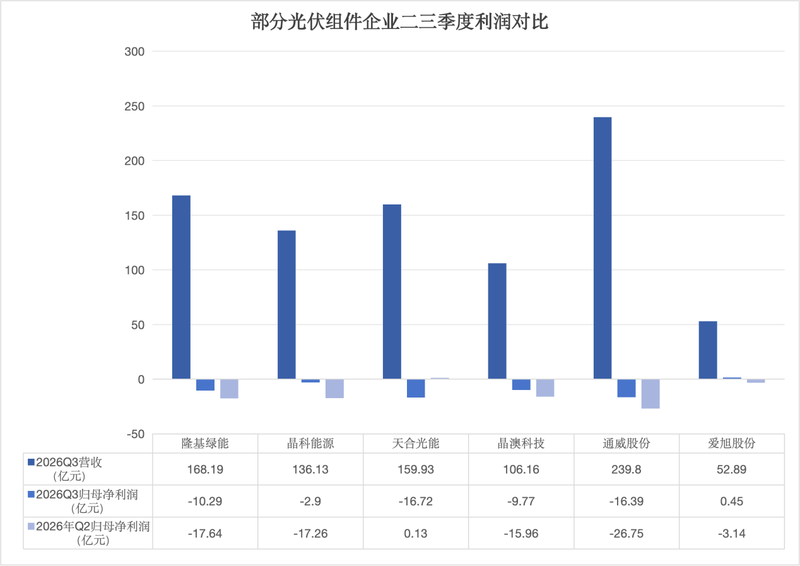
A-Xu Co., Ltd. (600732.SH), which released its third-quarter report ahead of schedule, became the only leading module manufacturer to turn a profit in the third quarter alone. The company reported revenue of 14.472 billion yuan for the first three quarters, with a net profit attributable to shareholders of -709 million yuan. In the third quarter, revenue reached 5.289 billion yuan, and the net profit attributable to shareholders was 44.5666 million yuan.
Regarding the turnaround to profitability, A stated that module sales volume increased year-on-year in the third quarter, selling prices rose, leading to higher revenue, gross profit, and net profit. A research report by China Merchants Securities indicated that A-Xu Co., Ltd.’s single-quarter gross margin in the third quarter was approximately 13.3%, an increase of about 5 percentage points from the previous quarter. The company achieved full production and full sales of its ABC modules, with shipments of approximately 5.4 GW.
In a September investor interaction session, A-Xu Co., Ltd. stated that the adoption of its ABC module products by major domestic and international customers continues to expand. Sales orders are robust, with current on-hand module orders reaching approximately 15 GW. Customer intended procurement demand consistently exceeds the company’s production capacity, and orders for related products have been scheduled through the first half of 2027.
Jinko Solar (688223.SH), which reduced its losses by over 1.4 billion yuan quarter-on-quarter in the third quarter, cited the contribution of its energy storage business as one of the core factors behind its improved performance. The company reported revenue of 38.340 billion yuan for the first three quarters, with a net profit attributable to shareholders of -3.367 billion yuan, and a net profit of -4.046 billion yuan after deducting non-recurring gains and losses. In the third quarter, the net profit attributable to shareholders was -290 million yuan, a reduction of 722 million yuan year-on-year and 1.436 billion yuan quarter-on-quarter.
In recent roadshow exchanges, Jinko Solar stated that its energy storage business achieved its first single-quarter operating profit in the third quarter, with confirmed revenue of 1.75 GWh and a gross margin of 15% to 20%. The company expects the confirmed revenue scale of its energy storage systems to continue growing rapidly in the fourth quarter. Furthermore, it anticipates a significant increase in the proportion of energy storage shipments and revenue next year, with the confirmed revenue scale expected to grow by nearly 100%.
Jinko Solar indicated that in response to the intensifying competition in the large-scale energy storage market next year, the company will leverage its integrated solar and storage advantages to focus on expanding commercial and industrial energy storage. It plans to increase the business share of this segment from 5% to 10% this year to approximately 20% next year, and expects the net profit margin of its energy storage business to reach 5% to 10%.
The energy storage business is becoming a key lever for photovoltaic companies to develop a second growth curve and improve their operational performance.
Zhong Baoshen, Chairman and General Manager of LONGi Green Energy (601012.SH), stated at the earnings conference on November 3 that the sales volume of energy storage products with confirmed revenue in the first three quarters of 2026 was approximately 1.6 GWh. There will be discrepancies between the sales volume corresponding to confirmed revenue and the signed order volume, primarily influenced by factors such as the grid-connection progress of downstream customer projects.
Zhong Baoshen mentioned that the company’s current energy storage business orders have exceeded 3 GWh. The company will build a comprehensive product matrix around diverse scenarios, including large-scale power stations, commercial and industrial applications, and microgrids, while accelerating its global business expansion.
From Scale Expansion to Profit Priority: The Industry’s Competitive Logic Is Shifting
The third-quarter performance of photovoltaic companies showed marginal improvement, but the industry is still far from fully emerging from the downturn. Against the backdrop of sustained pressure across the sector, the primary business objective is no longer simply pursuing shipment volume; the importance of profitability and cash flow security has become even more pronounced.
According to statistics from InfoLink, the total shipment volume of the top ten global module suppliers in the first half of 2026 decreased by 31% year-on-year; during the same period, the shipment volume of the eight companies that appeared on the list consecutively decreased by 30% year-on-year.
Multiple companies have explicitly stated that they are shifting their operational focus to profitable sales. JinkoSolar stated that the company has fully transitioned to a profit-first operational objective; in terms of capacity construction, it will adopt a more prudent strategy, avoiding the rapid and large-scale introduction of all forward-looking technologies into production capacity.
JA Solar also stated that during the industry’s bottom phase, the company prioritizes cash flow security in its operations, proactively optimizes order structures, strengthens collection management and fund control, and maintains a stable operational foundation.
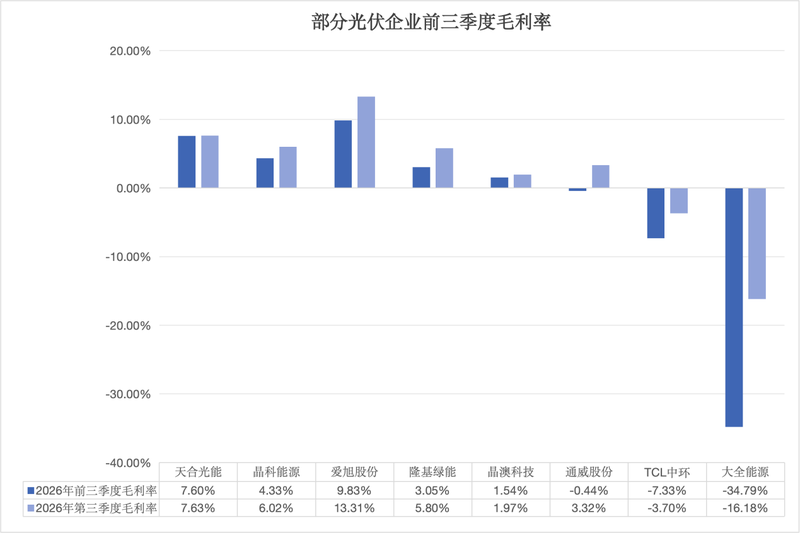
From the perspective of profitability metrics, reporters from Beike Finance noted that the gross profit margins of several photovoltaic companies in the third quarter showed a recovery compared to the second quarter. However, looking at the price trends across the industry chain, aside from a relatively noticeable price increase in the polysilicon segment, prices for wafers and modules did not experience significant changes.
This indicates that the current improvement in corporate profits is not solely driven by rising prices across the industry chain. Factors such as market positioning, product structure optimization, and cost control are also playing a role.
JA Solar mentioned that in the first three quarters of 2026, the company shipped 36.22 GW of cells and modules, with overseas module shipments accounting for 60.92% of the total. The company stated that its global market layout continues to serve as a hedge against domestic price pressures.
JinkoSolar also noted that, with TOPCon as its core product line, the company will launch more scenario-specific products targeting the distributed market, focusing on high-value markets while optimizing its product and customer structures. The company believes that as the proportion of its high-efficiency Feihu 3 product in total module shipments increases, its profitability will improve.
“The company is not pessimistic about 2027 and believes performance will not be worse than in 2026,” JA Solar stated. It added that the national high-quality development strategy and policies issued by relevant departments, including mandatory standards and measures to curb excessive internal competition, will gradually take effect. The company forecasts that global installation capacity in 2027 will range between 528 GW and 660 GW, with China’s total installation capacity remaining at 275 GW to 280 GW, still accounting for approximately 45% of the global market share. Overseas markets are expected to be the primary source of future growth.
Judging from the third-quarter performance, photovoltaic companies have shown certain signs of marginal improvement. However, the sources of loss reduction, the sustainability of profit recovery, and changes in industry supply and demand dynamics remain to be observed. For photovoltaic companies, a true turning point signifies not only a narrowing of losses but also the formation of a more stable positive cycle involving industry chain prices, supply-demand relationships, and corporate profitability.
Frequently asked questions
Did Aiko Solar achieve a single-quarter profit in Q3, and what was the primary driver behind this financial turnaround?
Aiko Solar became the only leading module manufacturer to turn a profit in the third quarter. This achievement was driven by product mix adjustments and business diversification rather than a clear rebound in module prices.
What was the confirmed revenue sales volume for Gi Green Energy's storage products in the first three quarters of 2026?
Gi Green Energy reported approximately 1.6 GWh in confirmed revenue sales for energy storage products during the first three quarters of 2026. This figure differs from signed order volumes due to grid-connection progress and other operational factors.
Why do analysts argue that the current narrowing of losses does not yet represent a true industry turning point for solar developers?
A true turning point requires a stable positive cycle involving industry chain prices and supply-demand relationships, not just loss reduction. Current improvements are primarily driven by business diversification, while module prices have not shown a clear rebound.