Exclusive: Apartment Complexes Banning Balcony Solar Panels Misapplied Management Rules

Can the long-delayed “era of rooftop solar for every home” finally begin?
On May 19, the Ministry of Climate, Energy and Environment (MCEE) formulated and released the “First Basic Plan for Renewable Energy.” As the first basic plan for renewable energy aimed at the energy transition, it carries significant implications. A notable aspect is its ambitious goal to revitalize “home solar.” The plan expresses the intent to not only reduce heating and cooling costs through personal solar installations but also to establish a foundation for households to generate and sell electricity directly. This includes plans to promote balcony solar installations in 2 million households and to issue “Renewable Energy Generation Guarantees (REGOs),” allowing individuals to earn additional income by selling certificates for renewable energy generated at home. Personal solar is thus becoming a “livelihood policy” that contributes to national income.
In April this year, the MCEE also secured 37.5 billion won for the household solar promotion program through a supplementary budget. For the first time, the term “household solar” appeared in the central government’s budget. The plan aims to promote household solar in 25,000 households in Seoul and 75,000 households in other regions. A total of 56 metropolitan and provincial local governments across the country have expressed their intent to participate in the program.
However, it remains questionable whether personal solar adoption will expand as the government intends. According to data obtained by the office of Rep. Seo Wang-jin of the Democratic Party of the People from the Korea Energy Agency on September 16, the demand for household solar from local governments nationwide is estimated at 13,629 households, with a national subsidy of approximately 3.9 billion won. The “actual demand” here refers to the “project demand” calculated after considering the scale of local funds that local governments can independently allocate. Consequently, it has been pointed out that 90 percent of the 37.5 billion won allocated this year is likely to remain unspent or be carried over. The promotion program is structured so that the national government covers approximately 30 percent of the total project cost, with the remainder funded by local governments. The issue is that local governments were not prepared to match their budgets with the government’s.
Local governments cite a lack of provincial and municipal funds to match the government’s program as a reason for the difficulty in expanding the promotion project. Would increasing the share of national funding to improve local implementation conditions resolve this issue? On the ground, it is described as a “half-baked answer.” The first major obstacle blocking residents who want to install balcony solar and the contractors who build them is the apartment complex itself.
Im Cheon-su worked for eight years at the Gangseo-Yangcheon Citizens' Solar Power Cooperative, an organization that leases public land and other sites to install and operate solar power plants. The cooperative offered residential balcony solar installations until 2021 but has since discontinued the service. When asked why, the conversation turned to apartment management offices. “Many buildings cite various reasons to block installations. Newer, high-end apartments are particularly sensitive. In some cases, management offices have sent certified letters to residents, threatening lawsuits if the panels are not removed immediately.”
Person A, who handles pre-installation inspections at a small-scale solar installation company, also stated that the first hurdle for balcony solar installations is the apartment’s management bylaws. “If the management office forbids installation, residents cannot proceed even if they want to. We believe that resolving just this issue would allow the industry to grow. As more balcony solar installations appear, we will have more evidence that safety incidents and glare are not concerns, which is frustrating. Some people still believe that solar panels could be blown away during a typhoon. As long as the railings remain intact, that is not a realistic risk.”
〈SisaIN〉 and the climate and environmental organization “Plan 1.5” set out to examine how apartment management bylaws affect the installation of household solar power systems. Through the office of Democratic Party of Korea lawmaker Park Ju-min and the Center for the Right to Know, they first obtained data on electricity consumption per unit area for 3,546 apartment complexes in Seoul (March 2024 to February 2025). During this period, the average electricity consumption per unit area across all apartments was 39.18 kWh. The average consumption for the top 15 apartments with the highest electricity use was 68.34 kWh, which is 1.7 times the overall average and 3.2 times the average of the 15 complexes with the lowest consumption (21.18 kWh).
From among the apartments with high electricity consumption, they further identified large-scale complexes with more than 1,000 units. They then contacted 132 such complexes by phone to inquire whether balcony solar installations are permitted. In a context where electricity demand continues to rise, they sought to determine whether these high-consumption apartments allow even minimal “self-generation” of power.
Even in buildings where balcony solar panels are permitted, management rules state that they must be removed if complaints are received.
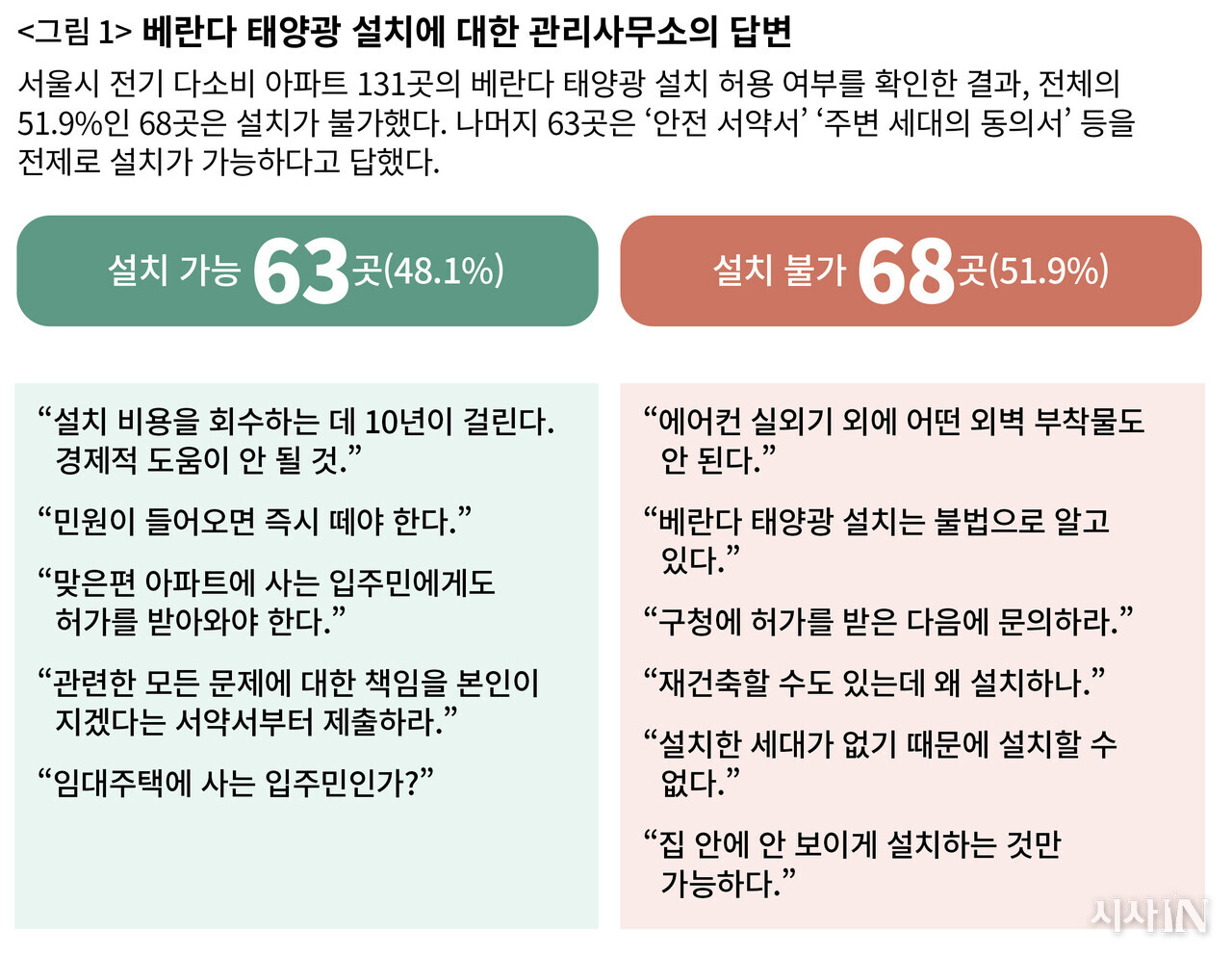
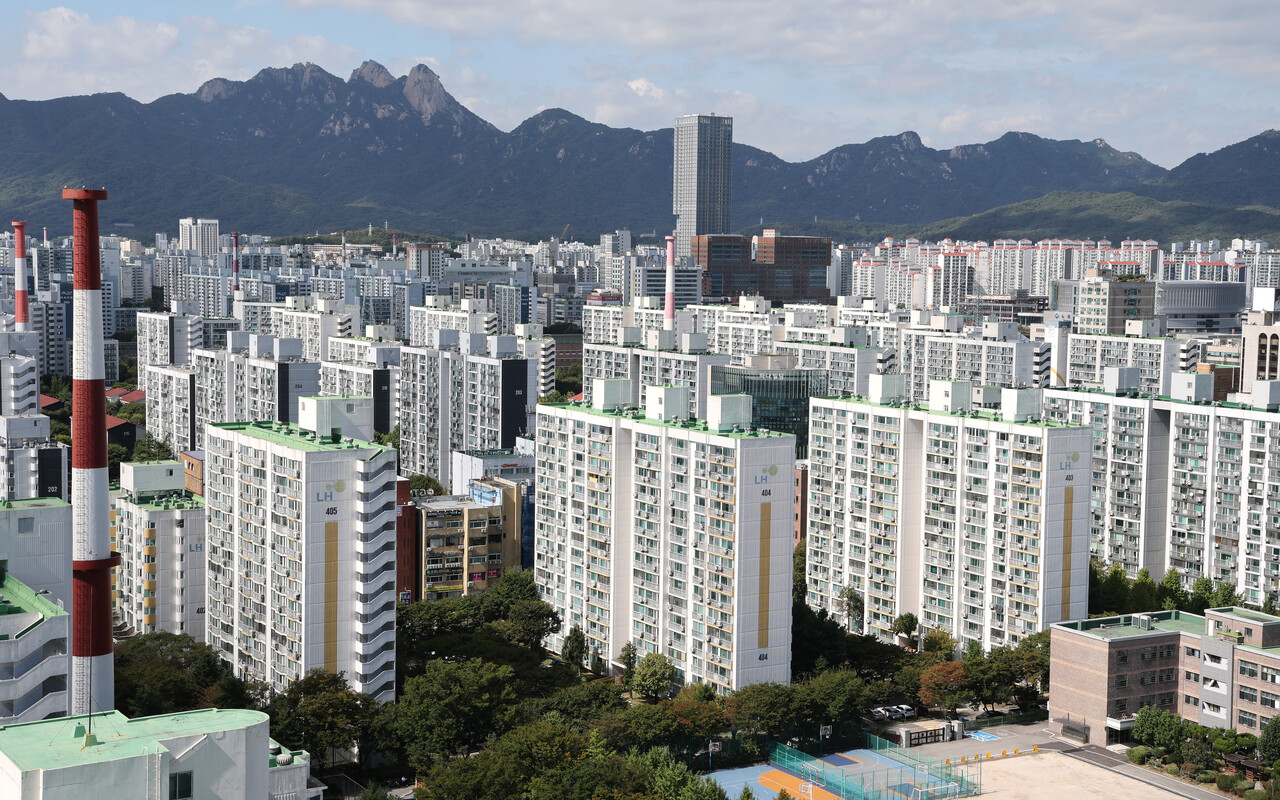
Of the 131 residential complexes surveyed, excluding one that did not respond, 68, or 51.9% of the total, stated that the installation of balcony solar panels was not permitted. The remaining 63 complexes indicated that installation was possible, with the majority conditioning this on prerequisites such as a “safety pledge” and “consent from neighboring households” (see Figure 1).
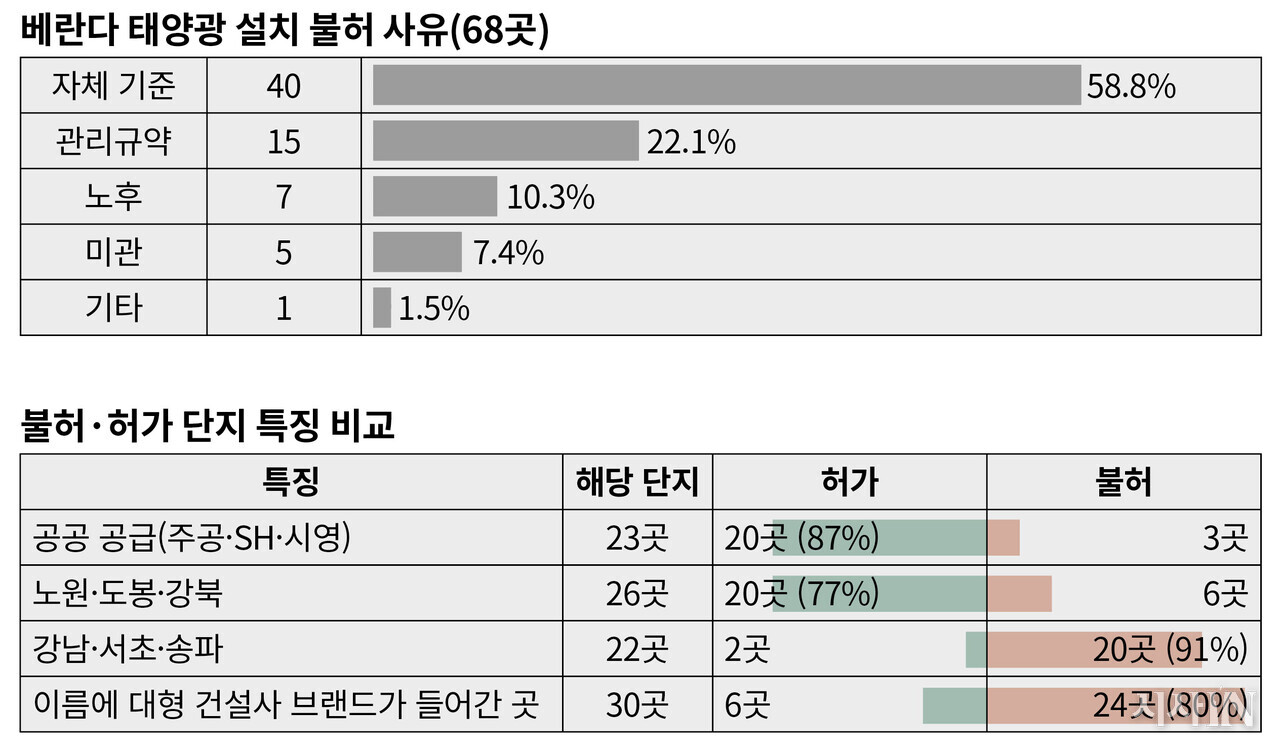
In the three districts of Gangnam (Gangnam-gu, Seocho-gu, and Songpa-gu), 20 out of 22 apartment complexes do not permit the installation of balcony solar panels, resulting in a rejection rate exceeding 90%. When compared by district, Gangnam-gu had the highest rejection rate. Of the 68 complexes that rejected installations, 11, or 16.2%, were located in Gangnam-gu. Nowon-gu had the highest number of apartment complexes that allowed solar panel installations. It was a “pro-solar” district, with 13 of the 63 complexes that permitted installations concentrated in Nowon-gu.
There is a reason behind Nowon-gu’s “strong performance.” Following the Fukushima nuclear accident in the 2010s, the Seoul Metropolitan Government sought to increase its energy self-sufficiency rate through initiatives such as the “One Less Nuclear Plant Policy” (2012) and the “Solar City Seoul Plan” (2017). Aiming to deploy 1 gigawatt of solar capacity and install mini solar power plants in one million households, the city distributed balcony solar panels to 125,763 households between 2014 and 2021. However, after Mayor Oh Se-hoon returned to office in 2021, the policy direction shifted, leading to a reduction in support and a retreat in the city’s self-consumption solar policy.
This trend of retreat continues to this day. According to the “Seoul Metropolitan Climate Change Response Comprehensive Plan (2022–2026),” the city set targets to achieve a renewable energy adoption rate of 12.6% by 2026 and 21% by 2030, measured as the proportion of renewable energy in total electricity consumption. However, documents obtained by “SisaIN” through the office of Rep. Park Ju-min indicate that the city’s current target renewable energy adoption rates have dropped to 6.6% for 2026 and 12.3% for 2030, representing decreases of 6 percentage points and 8.7 percentage points, respectively. Since taking office, Mayor Oh Se-hoon has also suspended or scaled back solar-related support programs. New support for the Seoul-style Solar Power Support Project was halted in 2022, and the low-interest loan support policy for installation costs saw its budget cut by approximately 95% in 2022 compared to 2021, effectively rendering it defunct. The selection and support for energy self-sufficient villages were also abolished starting in 2023.
Nowon-gu continues its solar expansion policy by covering 80% of the total installation cost for balcony solar panels. In this survey, some apartment management offices in Nowon-gu responded positively to solar installations, stating, “Since some households have already installed balcony solar panels, you are free to do so as well.”
On the other hand, among apartments that permit solar installations, many expressed negative reactions, stating that they “discourage it due to low efficiency,” “require immediate removal if complaints are filed,” or “demand a signed pledge assuming full personal responsibility first.” Some even asked whether the resident lived in a rental unit. Kim Hye-mi, a policy activist at Plan 1.5 who conducted the survey alongside the team, stated, “We could feel that in multi-dwelling housing, the most common residential form in urban areas, solar power is perceived less as a means of producing eco-friendly energy and more as a sensitive source of complaints.”
Let’s examine the specific findings. What are the reasons behind the 68 apartment complexes that do not permit the installation of balcony solar panels? The most frequently cited reason among these complexes was that they “decided not to allow it based on their own criteria.” This applied to 40 out of the 68 complexes (58.8%). Some responses claimed that the decision was made by the residents’ representative council, but only one complex explained when and through what procedure the decision was made.
Those who mentioned “their own criteria” responded as follows: “External attachments are prohibited in principle (Godeok-dong, Gangdong-gu),” “Why are you trying to install it when the complex may be redeveloped soon? (Gaepo-dong, Gangnam-gu),” “The apartment management does not allow it (Heukseok-dong, Dongjak-gu),” “It is not allowed because no households have installed them (Sangil-dong, Gangdong-gu),” and “Installation is only possible inside the apartment (Banpo-dong, Seocho-gu).”
In some cases, the information provided was factually incorrect. Examples include: “We understand that balcony solar panel installation is illegal (Banpo-dong, Seocho-gu)” and “Obtain approval from the district office and contact us again (Jamsil-dong, Songpa-gu).” In reality, balcony solar panel installation does not require permission or approval from the district office. The entire procedure involves residents obtaining consent from the management office and then coordinating with a construction company for installation.
It is also evident from other cases that the primary variable determining whether balcony solar panel installation is permitted is the “subjective judgment” of the management office and similar entities. This is illustrated by the following statement from an individual, referred to as Person N, who has served as a management office director for 14 years: “There is no provision in the management bylaws that prohibits balcony solar panel installation, but I would still persuade residents not to install them. I have not received any related inquiries in recent years, but there are always residents who dislike it because they believe it damages the building. Since complaints may arise, it inevitably leads to increased management workload. In the past, we would post notices from the district government regarding subsidy support, but that has also disappeared in recent years. Isn’t it now the norm not to install solar panels?”
There are also cases where solar panel installation is permitted in some complexes but prohibited in others, even within the same residential area. For example, in the Mokdong apartment district, six complexes allow balcony solar panel installation, while six others do not. Despite being built around the same time with similar structures, each complex made a different decision. The reasons for prohibition also varied. Three complexes responded that they do not allow it in accordance with their apartment management bylaws.
The rest cited the apartment complex’s own standards or concerns about damage to the building’s exterior. Statements included “Our complex has decided not to allow it,” “The building is old and poses a safety risk,” and “We do not allow any protruding structures other than air-conditioning outdoor units because they damage the exterior.” Given that other complexes built during the same period permit balcony solar installations, it is difficult to consider the argument about “aging” or the judgment that balcony solar panels damage the exterior while air-conditioning outdoor units do not as equitable reasons. Balcony solar panels are installed using brackets attached to the railing, which does not damage the walls, and can be easily removed and reinstalled when residents move in or out.
The claim that “it is not allowed under the management bylaws” is a lie
The claim that “it is not allowed under the management bylaws” warrants careful scrutiny. Of the 68 complexes that blocked balcony solar installations, 15 (22.1%) cited the same basis. A review of the management bylaws of these complexes, as published on the “Integrated Information Plaza for Multi-Housing” site operated by the Seoul Metropolitan Government, revealed that this claim was largely inaccurate. The bylaws of 14 out of the 15 complexes did not “prohibit” the installation of balcony solar panels.
Most apartment complexes refer to the “Standard Guidelines for Multi-Housing Management Bylaws,” established by local governments in accordance with the Multi-Housing Management Act, when drafting their own bylaws. These guidelines are public resources designed to mediate various disputes among residents and to ensure the transparent and efficient management of residential complexes. Bylaws may be amended as needed, subject to resolutions by the Residents’ Representative Council and approval procedures by residents. The Seoul Metropolitan Government revises its detailed bylaws almost annually, with the “19th Amendment to the Seoul Metropolitan Government Standard Guidelines for Multi-Housing Management Bylaws (Seoul Standard Management Bylaws),” revised in March 2026, representing the latest version.
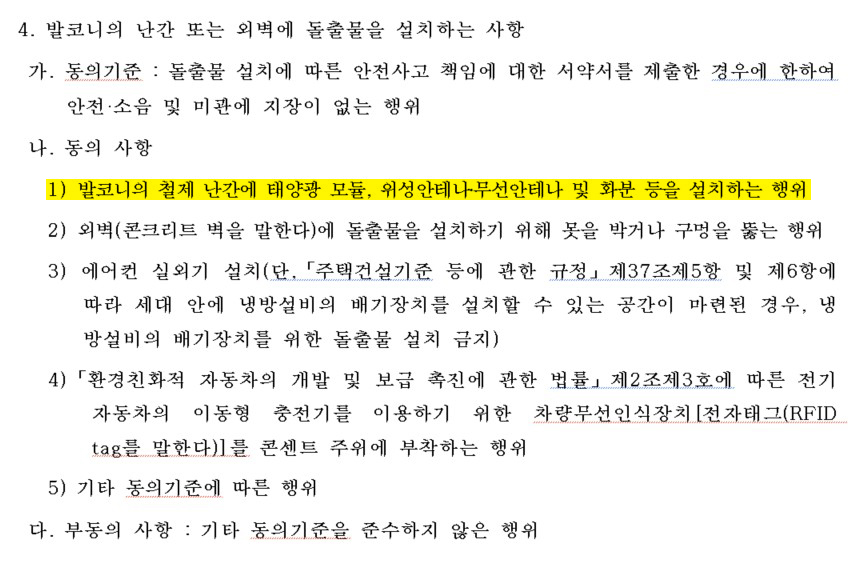
The bylaws of the 14 complexes largely mirrored this Seoul standard. Under these guidelines, the installation of balcony solar panels falls under “matters requiring consent” from the management entity (management office). Only one complex, located in Seodaemun District, classified such installations as “matters requiring non-consent.” “Matters requiring non-consent” refer to actions that are prohibited without room for reconsideration due to substantial harm to residents or specific safety risks. Examples include parking a vehicle in a fire truck-only zone and obstructing traffic, loading or parking items in a traffic lane, or installing large advertising structures within a multi-housing complex.
In contrast, for balcony solar installations, the management body is required to grant consent only when the resident has submitted a liability agreement for safety incidents and when the installation does not interfere with safety, noise levels, or aesthetics, similar to the conditions applied to wired or wireless antennas, flower pots, and air-conditioning outdoor units (see Figure 2). The fact that this is listed under “items requiring consent” implies that, once the stated conditions are met, the installation should be permitted to the greatest extent possible to serve the welfare of the residents. Yoon Se-jong, a policy activist at Plan 1.5 and a licensed attorney, stated, “The requirement for the management body’s consent does not mean that the on-site manager has been granted absolute discretion and authority to act as he sees fit.” “It is the management body’s duty to rationally assess and determine whether the safety risks are real rather than based on prejudice, whether the noise generated is significant enough to affect the quality of life of others, and whether the installation compromises the building’s aesthetics. Failing to conduct any such review and uniformly deciding that installation is not permitted (i.e., withholding consent) runs counter to the intent of the agreed-upon bylaws.”
One might question this. The apartment management bylaws are a “self-governing charter” that defines the rights and obligations of residents, essentially a form of “self-regulation.” Under this view, would it not be perfectly acceptable to amend the bylaws to classify balcony solar panel installations as a “matter requiring unanimous consent”? This perspective holds that the apartment, as a space where property rights are exercised, belongs exclusively to its residents.
A 2025 paper titled “A Study on Legal Issues Surrounding Joint Housing Management Bylaws” by Dr. Jeong Myeong-im, published in the academic journal “Legislation” issued by the Legislation Office, points out that “joint housing management bylaws,” established to ensure proper apartment management, possess a public law character and are subject to public regulation. This is supported by the fact that the government mandates the creation of management bylaws through legislation, requires reporting to administrative authorities when these bylaws are enacted or amended, and imposes administrative fines for violations in accordance with the law. “Properly managing an apartment” is also a public act related to improving the standard of residential life for citizens. The paper argues that substantive public regulation is necessary when joint housing management bylaws “seriously restrict the rights of specific households or cause arbitrary discrimination, significantly impacting the residential life and rights of a minority of residents.”
From this perspective, the debate over air conditioner outdoor units can be revisited. In the past, conflicts among residents arose over air conditioner outdoor units installed on apartment exterior walls. In response, the government amended the Standards for Housing Construction in 2006, mandating the installation of outdoor unit spaces within individual units. For complexes that applied for project approval after 2006, air conditioner outdoor units must be placed inside the residence. Subsequently, related provisions were revised through the Enforcement Decree of the Act on the Management of Joint Housing (2016) and the Enforcement Decree of the Building Act (2021), including restrictions on exterior wall installations and the relaxation of area calculation standards.
If outdoor units are not allowed, does that mean solar panels are also prohibited?
A significant number of apartment complexes have responded, “Just as air conditioner outdoor units cannot be installed externally, balcony solar installations are also not permitted.” However, air conditioner outdoor units and solar panels are different. Solar panels, which require sunlight in an open space, must necessarily be installed on the exterior walls of the apartment building.
Germany, while acknowledging the public interest nature of solar energy, grants a “right to request installation” for such exterior protrusions. Germany refers to balcony solar as “balcony power plants (Balkonkraftwerk).” It has actively pursued solar promotion strategies, including the “National Strategy for Solar Expansion” in 2023 and the “Solar Package I” in 2024. As a result, the number of installed balcony solar systems surpassed one million in 2025. This achievement is underpinned by a foundation for expanding residential solar installations that has been built over several years.
In 2021, the Stuttgart Regional Court in Germany dismissed a lawsuit filed by a landlord seeking the removal of a tenant’s balcony solar installation. The court noted that the installation was legally compliant with building regulations, did not harm the building’s appearance, was easily removable, and was installed safely. It also emphasized that solar energy contributes to achieving the “environmental protection” objective stipulated in the German Basic Law (Constitution). In 2024 and 2025, relevant laws were amended to stipulate that communities cannot refuse the installation of balcony solar systems themselves, but may only impose conditions on the installation method and location through a resolution process.
Kim Tae-geun, a lawyer and member of the Central Joint Housing Management Dispute Mediation Committee, stated that disputes surrounding balcony solar installations could increase significantly, similar to past legal disputes over air conditioner outdoor units. This is because conflicts may intensify as solar promotion policies expand under government leadership. Attorney Kim argued that apartments need to change. “The residents’ representative assembly could propose a direction. Currently, the management office often applies regulations based on its own convenience and assumptions about public opinion, without even confirming what residents want. If the management office is the executive branch, the residents’ representative assembly is the legislative branch. We must find solutions together that also respect the voices of tenants.”
According to the results of the second National Survey on Climate Crisis Awareness conducted in 2025 by the civil society coalition “Climate Politics Wind,” 60.4% of respondents expressed an intention to install solar power generation equipment for personal use. 78.1% of Seoul residents supported the expansion of mini solar support policies.
Frequently asked questions
Why are apartment complexes in South Korea incorrectly banning balcony solar panels under current management rules?
Apartment complexes are misapplying management rules by relying on subjective judgment rather than clear legal standards. This ambiguity allows management offices to deny installations based on personal discretion instead of objective criteria.
How many households does the Ministry of Climate, Energy and Environment plan to promote balcony solar installations in?
The ministry aims to promote balcony solar installations in 2 million households. This initiative is part of the First Basic Plan for Renewable Energy to revitalize home solar adoption.
What financial support did the Ministry of Climate, Energy and Environment secure for the household solar promotion program?
The ministry secured 37.5 billion won for the household solar promotion program through a supplementary budget. This marks the first time the term household solar appeared in the central government’s budget.