Spain to Boost Battery Capacity by Over 20x to Reach 6.5 GW by 2030

Spain’s battery storage capacity is set to grow by more than 20 times, reaching 6.5 GW by 2030.
The energy storage market in Spain is preparing for expansion over the next decade. According to forecasts by Aurora Energy Research, the installed capacity of battery energy storage systems (BESS) will increase from the approximately 300 MW currently in operation to 6.5 GW by 2030, and further to 9 GW by 2035.
In its analysis, the consultancy examines the revenues generated by the first standalone batteries operating in the country and the differences in billing resulting from their strategies for participating in electricity markets.
One of the findings pertains to a battery that achieved revenues of 200 euros per kilowatt (€/kW) during the first half of 2026, a figure that exceeds market expectations for this type of facility, according to Aurora.
The study shows that simultaneous participation in different segments of the electricity market can lead to differences in the revenues of these assets. However, it also anticipates a reduction in the value captured in certain services as the grid-connected storage capacity increases.
Battery storage projects in operation in Spain, by location, installed capacity and duration, as of September 2026. Source: Aurora Energy Research.
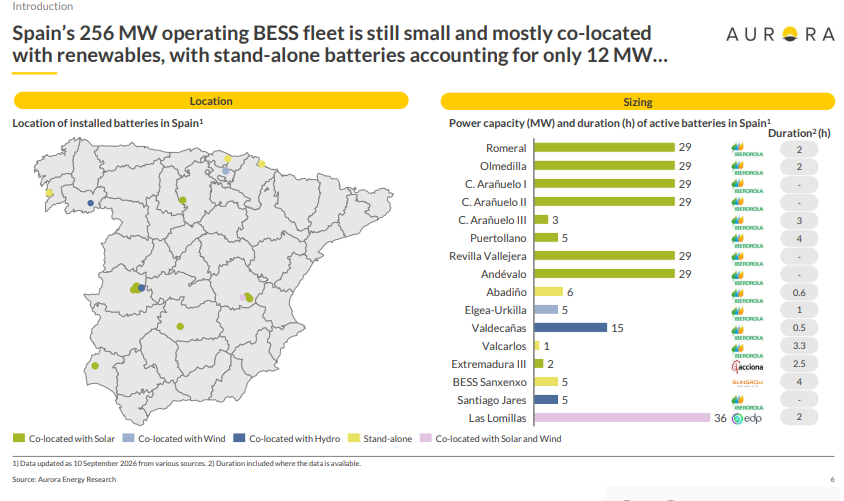
According to the inventory by Aurora Energy Research, updated as of September 10, 2026, Spain had 256 MW of operational battery capacity, of which 12 MW corresponded to independent (stand-alone) systems. The majority of the capacity was associated with renewable energy generation facilities.
The combination of markets determines battery revenues
Aurora analyzed the operation of the first independent batteries in operation in Spain and compared their actual revenues with the estimated revenues for a representative battery in the Spanish market during the first half of 2026.
To conduct this comparison, the consultancy used its energy modeling tool, Chronos.
The battery that recorded the highest revenues did not concentrate its operations exclusively in the day-ahead market, but instead distributed part of its activity between the intraday market and the ancillary services for reserve and energy.
In addition, it carried out virtual arbitrage operations, which contributed to increasing its revenue through the optimization of its commercial strategy.
According to Aurora, this behavior demonstrates the importance of managing the participation of storage systems in the various available markets, rather than relying on a single source of revenue.
“The commissioning of Spain’s pioneering 300 MW BESS underscores the importance of optimized dispatch to maximize revenues and allocate volumes across various markets, including the day-ahead market and ancillary services,” explained María Pérez-Tabernero, Product Manager at Aurora Energy Research.
Aurora anticipates a decline in revenue from ancillary services
Despite the results recorded during the first half of 2026, the consulting firm warns that the profitability of BESS systems will evolve as installed capacity increases.
The addition of several gigawatts of batteries could lead to a progressive saturation of ancillary service markets, reducing the revenue opportunities currently obtained by the first projects in operation.
This phenomenon will be compounded by the accumulated degradation of the batteries, which can also affect their ability to capture value over their lifetime.
Queralt Baizan, Research Associate at Aurora Energy Research, points out that “the cannibalization of ancillary markets will be the main factor affecting battery revenues in Spain in the coming years, as this market becomes saturated. Asset owners should prepare in advance for this phenomenon to protect themselves.”
However, Aurora believes that the development of other remuneration mechanisms could partially offset this trend, especially through the capacity market and voltage control services.
The capacity market and voltage control will open up additional revenue streams
The analysis identifies the capacity market as one of the potential revenue sources for Spanish batteries in the coming years.
According to Aurora, for certain projects, the revenue obtained through this mechanism will be necessary to achieve a target internal rate of return (IRR) of 12%.
The participation strategy will depend on factors such as contract duration, battery lifespan, investment and operational costs, the availability of other subsidies, and expected returns.
Benjamín Rodríguez, senior analyst at Aurora Energy Research, explains that the first capacity market auction will be decisive in determining the firmness ratios applicable to batteries and the availability requirements that the system operator will establish.
The consultancy also points out that project location will have an increasing influence on their revenues, both due to grid connection constraints and opportunities to participate in certain services, including voltage control.
In this context, Aurora forecasts that the expansion of storage to 6.5 GW by 2030 and 9 GW by 2035 will be accompanied by changes in the commercial strategies of operators.
The analysis concludes that revenue diversification and dispatch optimization will be key factors in the operation of BESS systems in Spain, in a market where the entry of new projects will alter the remuneration opportunities for batteries.
Frequently asked questions
What is the projected growth in Spain's battery storage capacity by 2030 according to Aurora Energy Research forecasts?
Spain's battery storage capacity is set to reach 6.5 GW by 2030, representing a more than 20-fold increase from current levels. This expansion will continue to 9 GW by 2035 as the market matures.
How much revenue did a specific Spanish battery generate per kilowatt during the first half of 2026, and how did it compare to expectations?
A battery in Spain achieved revenues of 200 euros per kilowatt during the first half of 2026, exceeding market expectations for such facilities. This performance highlights the potential for high returns through optimized dispatch strategies.
What operational strategies will be critical for battery operators in Spain as storage capacity expands to 6.5 GW by 2030?
Revenue diversification and dispatch optimization will be key factors for battery operators as new projects enter the Spanish market. Aurora anticipates that simultaneous participation in different electricity market segments will be necessary to maximize asset value.