Spain Has the Sun but Lacks 10 GW: What Is Hindering Industrial Self-Consumption?

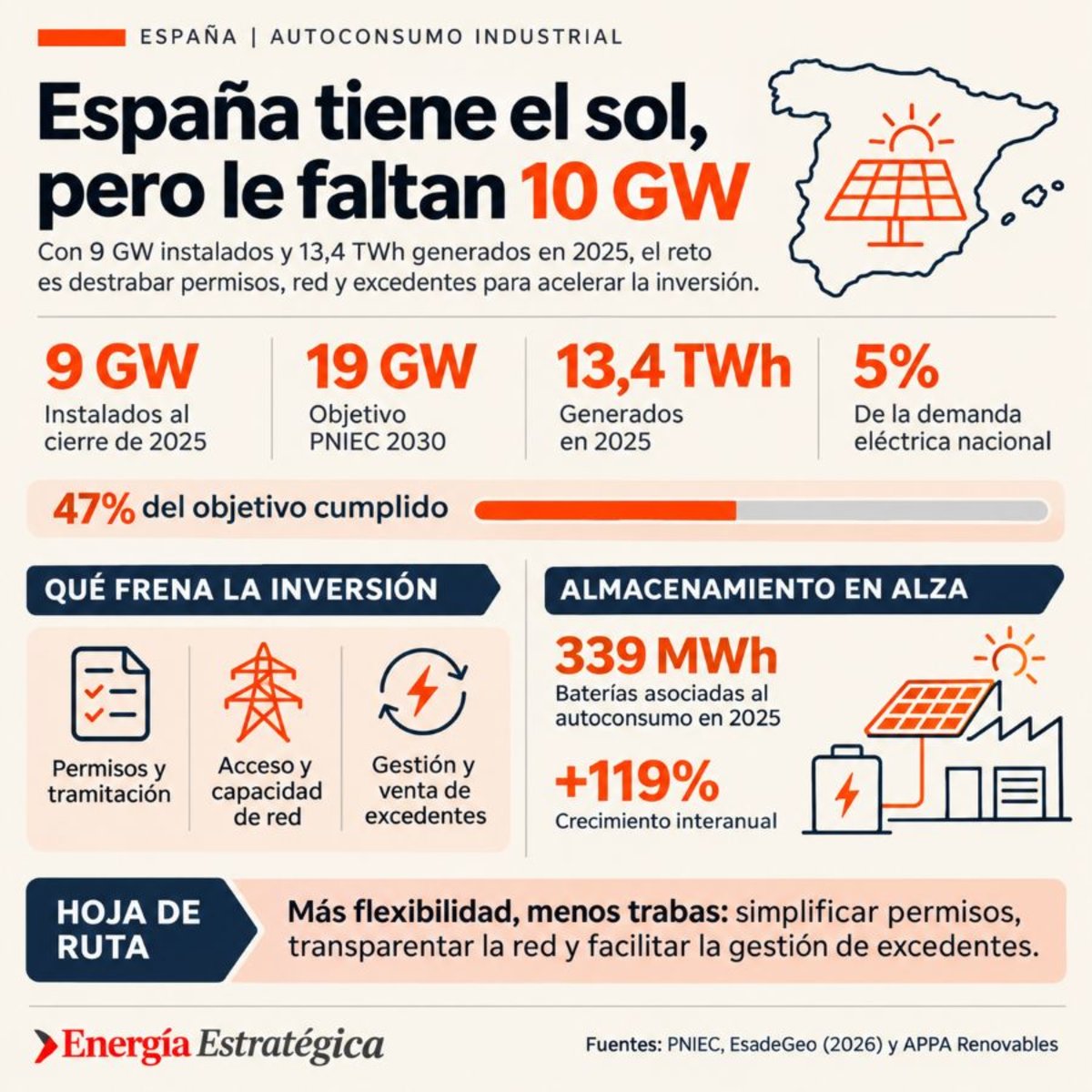
Spain must add approximately 10 GW of additional self-consumption capacity by 2030 to reach the 19 GW target set in the National Integrated Energy and Climate Plan (PNIEC). With approximately 47% of the target achieved by the end of 2025, the country faces a new phase of expansion in which industrial competitiveness is gaining increasing prominence.
Currently, the pace of expansion is far from the levels recorded during the sector’s boom. According to APPA Renovables, Spain added 1,214 MW of self-consumption capacity in 2025, a 15% decrease from the previous year, marking its third consecutive year of decline in new installations. Of this capacity, 846 MW corresponded to the commercial and industrial segment, accounting for nearly 70% of the total.
But what prevents an industry from fully leveraging its own renewable resources?
Grid capacity availability, administrative permits, and conditions for trading surplus energy can determine both the installed capacity and the economic return of each project.
For large industrial consumers, generating their own electricity allows them to reduce their exposure to market volatility. The integration of batteries expands this possibility by shifting energy to hours of higher consumption, while active demand management enables certain production processes to be adapted to the availability of renewable energy.
The opportunity extends beyond the Spanish market. Fossil fuels still account for 49.9% of final industrial energy consumption in the European Union, with natural gas representing 31.9%, while renewables and biofuels barely reach 11.3%. Meanwhile, the European Commission proposes increasing the continent's electrification rate from 23% to 46% by 2040.
In this context, a study by EsadeGeo, developed with the support of Amazon and published in October 2026, identifies six fronts to unlock industrial self-consumption: permitting, municipal governance, social acceptance, grid access, surplus management, and energy optimization. Its recommendations include differentiated permits, storage, and mechanisms to better leverage existing electrical infrastructure.
Permits, grids and surplus: the obstacles holding back industrial investment
In Spain, industrial facilities that sell surplus electricity may be subject to the same authorization regime as large power plants, with requirements for metering, settlement, and market representation that increase costs and prolong administrative procedures.
To address this, EsadeGeo proposes recognizing the strategic nature of industrial self-consumption and applying urgent procedures that allow certain administrative deadlines to be halved. The measure would cover hybrid projects, energy storage, and evacuation infrastructure.
It also calls for unifying municipal criteria, simplifying tax procedures related to the IBI, IAE, and ICIO, and improving the coordination of the €2.085 billion in self-consumption aid included in the PRTR, whose administrative fragmentation may hinder access for small and medium-sized enterprises.
Access to the grid constitutes another bottleneck. Although Spain has regulated the release of 10% of capacity at certain transmission nodes reserved for competitive bidding, its scope is limited for consumers connected to distribution networks. Therefore, the study proposes extending these mechanisms, increasing transparency on available capacity, and introducing flexible permits for facilities with surplus generation.
The impact already has an economic dimension. APPA estimates that 2,183 GWh of self-consumption could not be utilized during 2025 due to grid limitations and operational restrictions, with an estimated value of 82 million euros. The wasted energy equates to approximately 21% of the production actually used that year.
In previous dialogues with Energía Estratégica, Jon Macías, president of APPA Autoconsumo, warned about the underutilization of renewable generation when analyzing the electrical needs of data centers.
Read more
The capacity market versus project finance: What are the four new challenges for BESS in Spain?
“Spain does not have a structural problem of insufficient electricity generation. On the contrary, we are reaching very high levels of renewable energy curtailment due to technical constraints and lack of demand, resulting in the waste of approximately one-quarter of potential renewable generation, depending on the periods and criteria considered,” he stated.
Macías also advocated for objective criteria to allocate capacity in congested grid nodes and mechanisms that allow distinguishing mature projects from speculative initiatives, without establishing sectoral priorities.
Furthermore, in a recent LinkedIn post, the president of APPA Autoconsumo revisited the conclusions of EsadeGeo and emphasized the challenge of translating Spain’s renewable potential into new investments.
“Spain has an extraordinary advantage in renewable resources. The challenge now is much more difficult: converting that energy advantage into a competitive advantage,” he argued, pointing to execution as the condition for realizing industrial opportunities.
Storage and sale of surplus energy: the next business opportunities
EsadeGeo proposes dynamic tariffs and remuneration mechanisms for flexibility services, enabling industrial consumers to monetize demand management and participate in balancing markets.
It also suggests simplifying the sale of surplus energy, establishing transparent and, where appropriate, compensated curtailment restrictions, and preventing the double application of tariffs and charges to electricity stored for self-consumption.
These measures would allow for the better utilization of renewable generation during peak production hours, reduce demand peaks, and optimize existing grid infrastructure.
With the 2030 target on the horizon, the challenge will not be solely about installing more capacity, but ensuring that industry can store, consume, and trade its own electricity under competitive conditions.
Amazon reaches 76% self-sufficiency: 8 MWh batteries and hybrid generation
Energy storage is beginning to gain ground in Spain's self-consumption sector. According to APPA Renovables, 339 MWh of batteries were added in 2025, a 119% increase over the previous year, in a market seeking to better utilize its own generation and reduce its dependence on the grid.
An example of this integration is Amazon's BCN4 logistics center in El Far d'Empordà (Girona), which combines rooftop and canopy photovoltaic installations, a 2.2 MW wind turbine, and 8 MWh of batteries.
According to the company's estimates, the project achieves 76% annual energy self-sufficiency. Its intelligent management system allows for the storage of surplus energy, the shifting of consumption, and the reduction of grid injections during congestion episodes, thereby improving the utilization of generated electricity.
However, the incorporation of these technologies also poses administrative challenges. Adding batteries or wind generation to existing facilities may require new permits and urban planning assessments, even when the power fed into the grid does not increase.
Precisely to facilitate this type of project, Catalonia introduced changes through Decree-Law 22/2025, which simplifies certain procedures for self-consumption wind installations, eliminates the construction permit in certain cases, and establishes height criteria linked to aeronautical easements.
Frequently asked questions
How much additional self-consumption capacity must Spain add by 2030 to meet the PNIEC target of 19 GW?
Spain must add approximately 10 GW of additional self-consumption capacity by 2030 to reach the 19 GW target set in the National Integrated Energy and Climate Plan. This requirement exists because the country has only achieved about 47% of that target by the end of 2025.
What was the total self-consumption capacity added in Spain in 2025, and how did it compare to the previous year?
Spain added 1,214 MW of self-consumption capacity in 2025, representing a 15% decrease from the previous year. This figure marks the third consecutive year of decline in new installations for the sector.