30 Seconds of Charging for 10,000 Cycles: Sodium-Ion Battery Finally Finds Its Armor

Published in the Journal of the American Chemical Society, this breakthrough brings together Fudan University in Shanghai, Xiamen University, the Chinese Academy of Sciences, and the industrial player Shanghai Electric Group. Scientists Yanhua Wan and Wei Li have circumvented the premature wear of sodium-based batteries, a metal 1,000 times more abundant than lithium. Without inventing new chemical ingredients, the team reorganized the physical architecture of the component to withstand very high power levels while blocking long-term structural degradation.
How does this nanoscale architecture withstand such intense recharging cycles?
The secret lies in the assembly of an anode composed of double-walled hollow spheres, formed by titanium dioxide nanosheets measuring between 2 and 10 nanometers. Each sheet is individually encapsulated in a carbon shell mimicking graphene, with a thickness of just 0.4 nanometers. A simple mixture of materials did not work. It is this precise encapsulation that boosts electrical conductivity from 1.86 × 10⁻⁸ S/cm on the bare material to 3.55 × 10⁻⁴ S/cm.
This multiplied conductivity allows the component to withstand fast charging without structural disintegration. In the laboratory, at a rate of 10C (six minutes of charging), the component delivers 131 mAh/g and withstands 10,000 cycles, whereas bare sheets collapse after 400 cycles. Pushed to an extreme rate of 100C, meaning a full charge in thirty seconds, it still retains a capacity of 121 mAh/g.
Why do sodium ions typically degrade electrodes?
Integrating a sodium-ion battery into an electric vehicle has, until now, required choosing between charging speed and longevity. Sodium ions are physically larger than their lithium counterparts and move slowly through solid materials. To accelerate their movement, chemists reduce the electrode into tiny sheets, providing an enormous exchange surface area of 261 m²/g, compared to 76 m²/g for standard nanoparticles. The downside of this geometry is both mechanical and chemical, as the rapid influx of ions causes the material to swell, eventually leading to cracking.

Meanwhile, this large exposed surface reacts extensively with the liquid electrolyte, forming an unstable protective film that consumes sodium reserves. Without protection, the sheets lose nearly half of their metal during the first cycle, showing an initial efficiency of 55.6%. The carbon armor limits this direct contact and generates a much thinner inorganic sodium phosphate film, boosting the first-cycle efficiency to 80.1%.
What obstacles still hinder the industrial production of these cells?
Researchers validated their concept with a high active material loading of 10.5 mg/cm², retaining over 90% of its capacity after 3,000 cycles and achieving an areal capacity of 2.13 mAh/cm² (0.567 mAh/cm² at high current). Beyond a current density of 1 A/g, this design outperforms commercial hard carbon, which rapidly loses its low-voltage plateau. A full prototype combining this anode with a sodium vanadium phosphate cathode also sustained more than 170 cycles at 2 A/g. Nevertheless, the transition from the laboratory bench to industrial-scale manufacturing remains hypothetical.
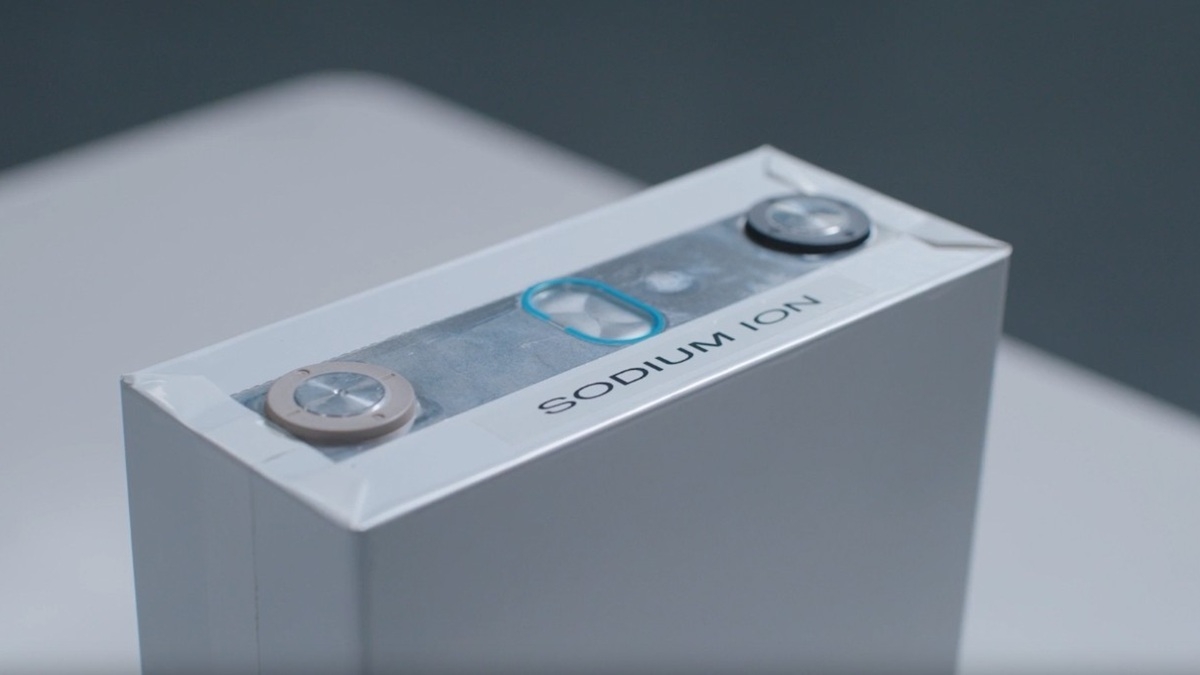
Tengfei Song, a researcher at the University of Birmingham, reminds us that this is a high-power material concept, not a commercial-ready product. All tests were conducted in button cells using metallic sodium to compensate for initial losses. Furthermore, this anode operates at an average voltage higher than that of hard carbon, which reduces the overall energy capacity of the battery. Even though giants like CATL and HiNa are already pushing sodium toward grid storage and automotive applications to compete with LFP (lithium iron phosphate) cells, Wei Li admits that maintaining a uniform coating on massive industrial volumes remains entirely unproven.
Frequently Asked Questions (FAQ)
What is the exact role of the graphene shell in this battery?
The 0.4-nanometer carbon shell serves three functions: it multiplies electrical conductivity to accelerate electron transfer, mechanically holds the nanosheets together to prevent cracking during intense charging, and isolates the material from the electrolyte to halt sodium loss.
Why is this component not yet ready for electric vehicles?
Performance was measured in tiny laboratory cells using an artificial sodium reservoir. The mass production of such a thin coating is not yet mastered, and the higher operating voltage of this anode reduces the total energy available in a complete battery.
Frequently asked questions
How did Fudan University and Shanghai Electric Group prevent premature wear in sodium-ion battery anodes without new chemicals?
The team reorganized the physical architecture to withstand high power levels while blocking structural degradation. This approach circumvents the premature wear of sodium-based batteries, a metal 1,000 times more abundant than lithium.
What specific conductivity improvement did the carbon-encapsulated titanium dioxide nanosheets achieve in the new sodium-ion battery design?
The precise encapsulation boosted electrical conductivity from 1.86 × 10⁻⁸ S/cm to 3.55 × 10⁻⁴ S/cm. This enhancement allows the component to withstand fast charging without structural swelling or cracking.
Why is the new sodium-ion battery anode not yet ready for electric vehicle deployment despite its lab performance?
Mass production of the thin coating is not yet mastered, and the higher operating voltage reduces total energy. Performance was measured in tiny laboratory cells using an artificial sodium reservoir, not full-scale systems.